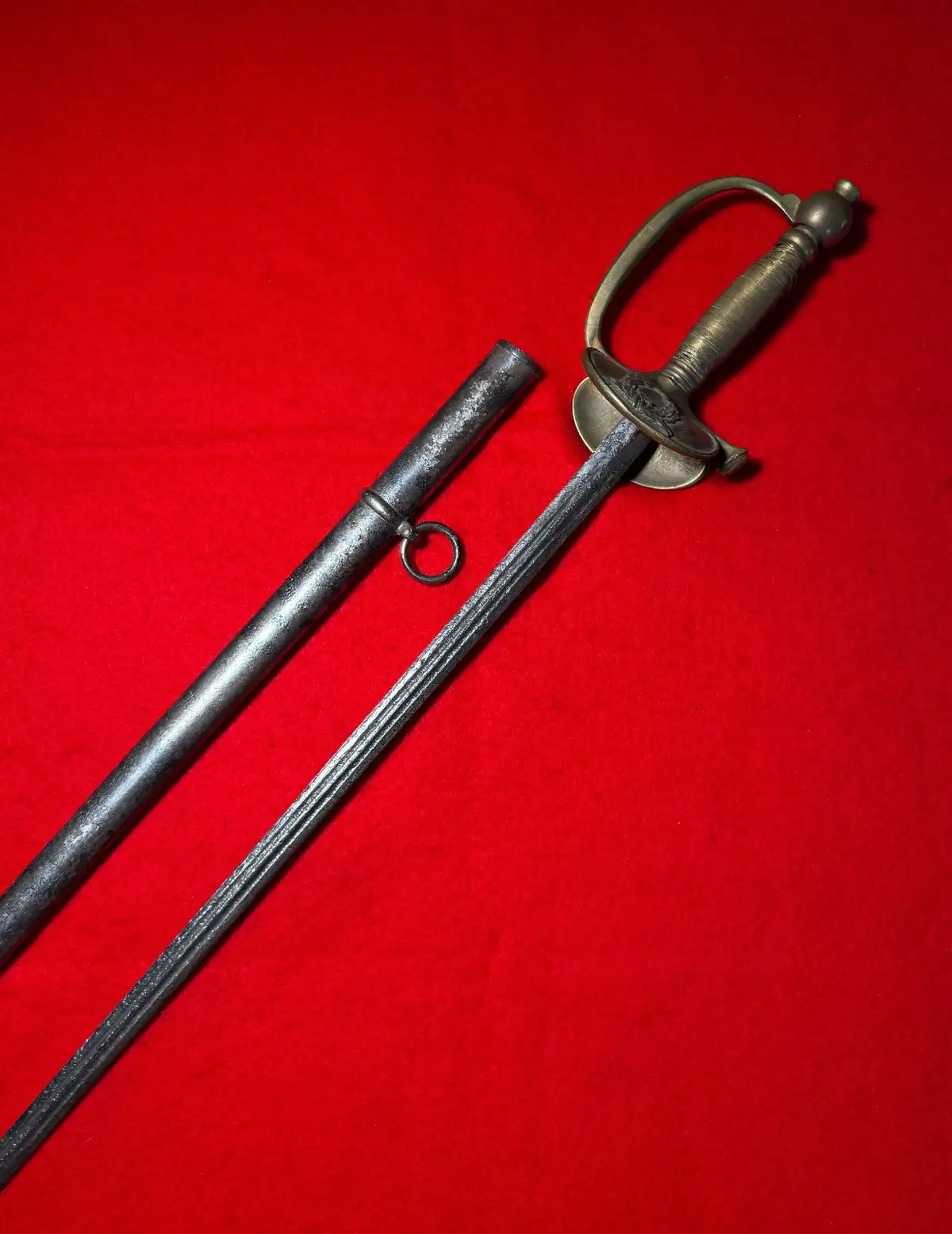
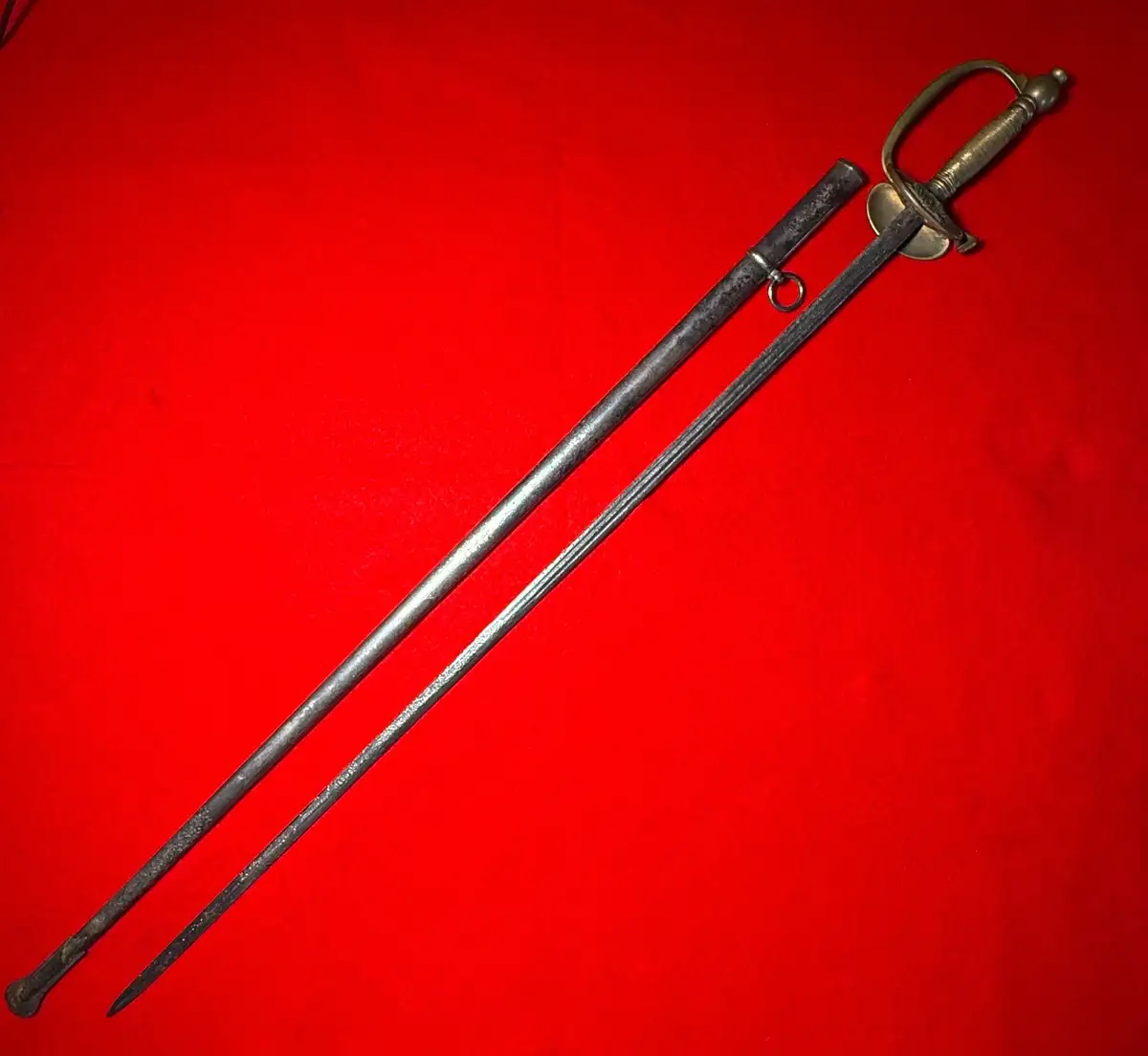
French M1872 Officer's Épée
Known in the trade as M1872 Épée.
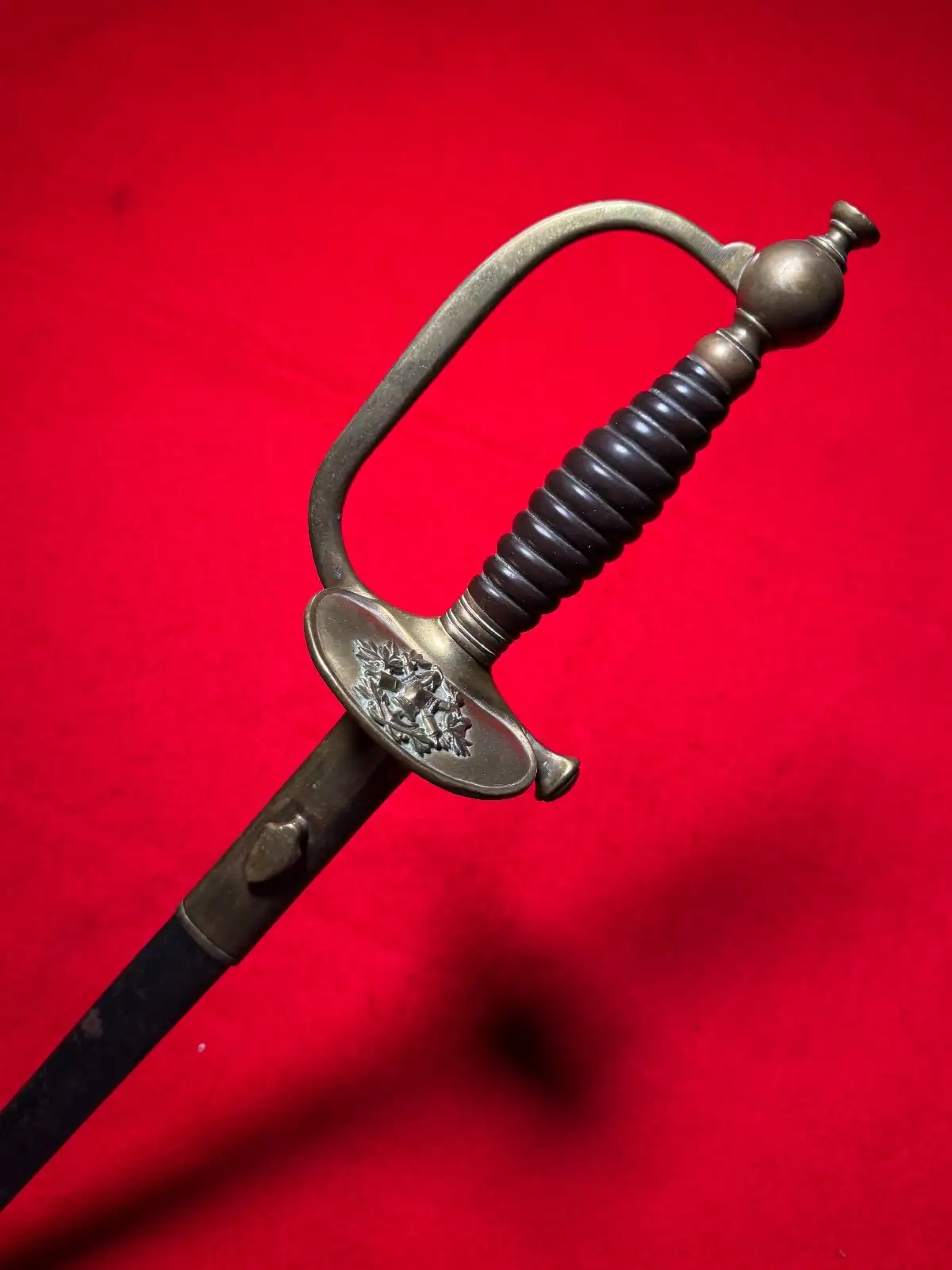
A decree of 19 March 1872 gave the Third Republic a family of officers' épées on one hilt; the version for junior officers of all arms and the administrative services is identified by the oak-and-laurel wreath in relief on its shell and by a counter-guard that latches folded and releases on a sprung steel ball.
Adopted 19 March 1872
A decree of 19 March 1872 gave the French army a sidearm for junior officers of every arm and for the administrative services. The full name is the épée d'officier subalterne de toutes armes et d'administration, modèle 1872. Collectors shorten it to M1872, and that shortening is where most of the confusion in this field begins.
The date is the point. The Third Republic was eighteen months old, proclaimed on 4 September 1870. The war had cost France her armies in the field, and the Treaty of Frankfurt had cost her Alsace and Lorraine. Where the Second Empire had run a scatter of épée patterns tied to individual branches, the new republic specified one hilt architecture and changed the iconography on the shell.
The crowned imperial eagle came off. In its place, on the version for all arms and administration, went a wreath of oak on the left and laurel on the right, tied with a ribbon and cast in relief on a plain ground — the device the Inventaire Général record calls the emblem of the Republic.
One warning before the wreath is used as a test. The same decree produced other claviers on the same hilt: the engineer version carries a trophy of engineer arms, the medical version a serpent, and a senior staff officer's version on a chiselled hilt carries an antique helmet over a glaive and six flags. The wreath identifies the toutes armes et administration version. It does not identify the modèle 1872.
An épée, not a sabre
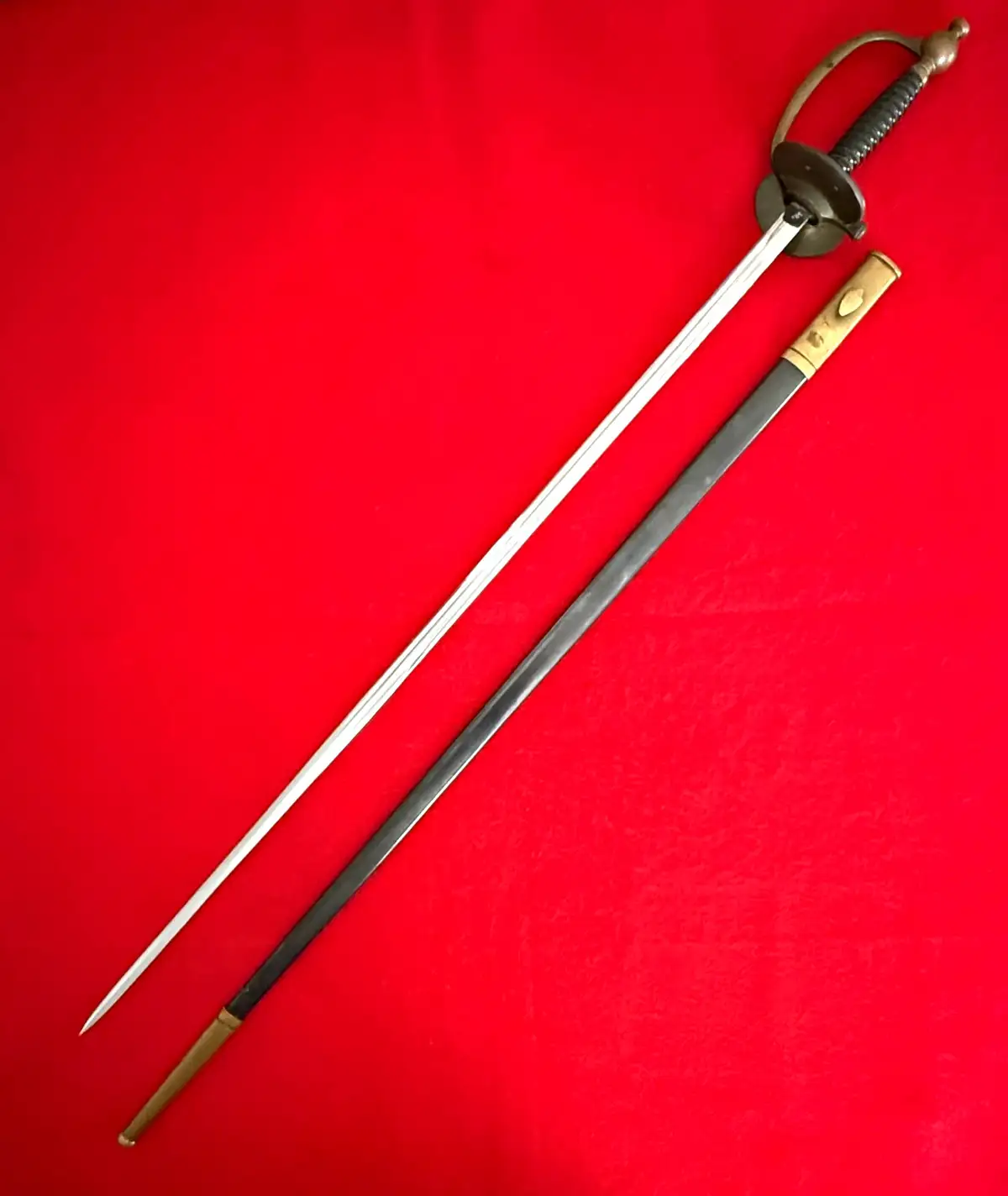
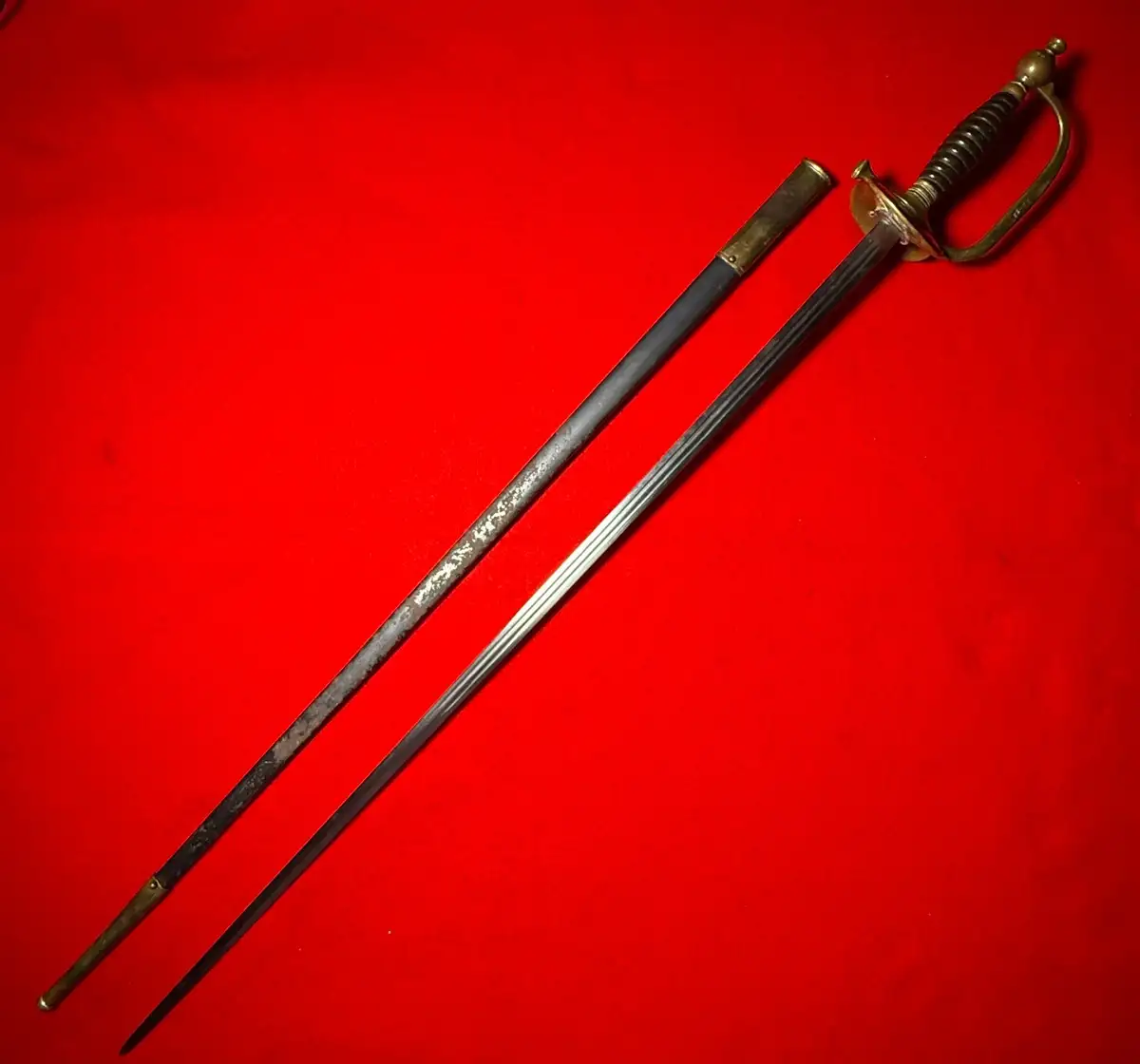
The M1872 is a thrusting sword. Straight blade, double-edged, with two narrow fullers running about the first half of the length from the shoulder, and on recorded examples a bodkin-like point.
Blade length does not identify this pattern. The Palissy record for one example gives 96 cm overall, 81 cm of blade and 15 cm of hilt — a useful arithmetic, because it lets you test whether a quoted overall figure includes the hilt or not. Recorded examples across the 1872 family run from about 76 cm to 88 cm in the blade and from 96 cm to 104 cm overall. French officers bought their swords from fourbisseurs, the outfitters who mounted blades to order, rather than drawing them from store, and the spread reflects that.
The sabre remained the infantry officer's sword: the modèle 1845 until 1882, then the modèle 1882. The épée was the regulation sidearm of junior officers of all arms and of the administrative services. Knowing which of the two you are holding settles half the pattern question before you look at anything else.
The hilt, where the pattern lives
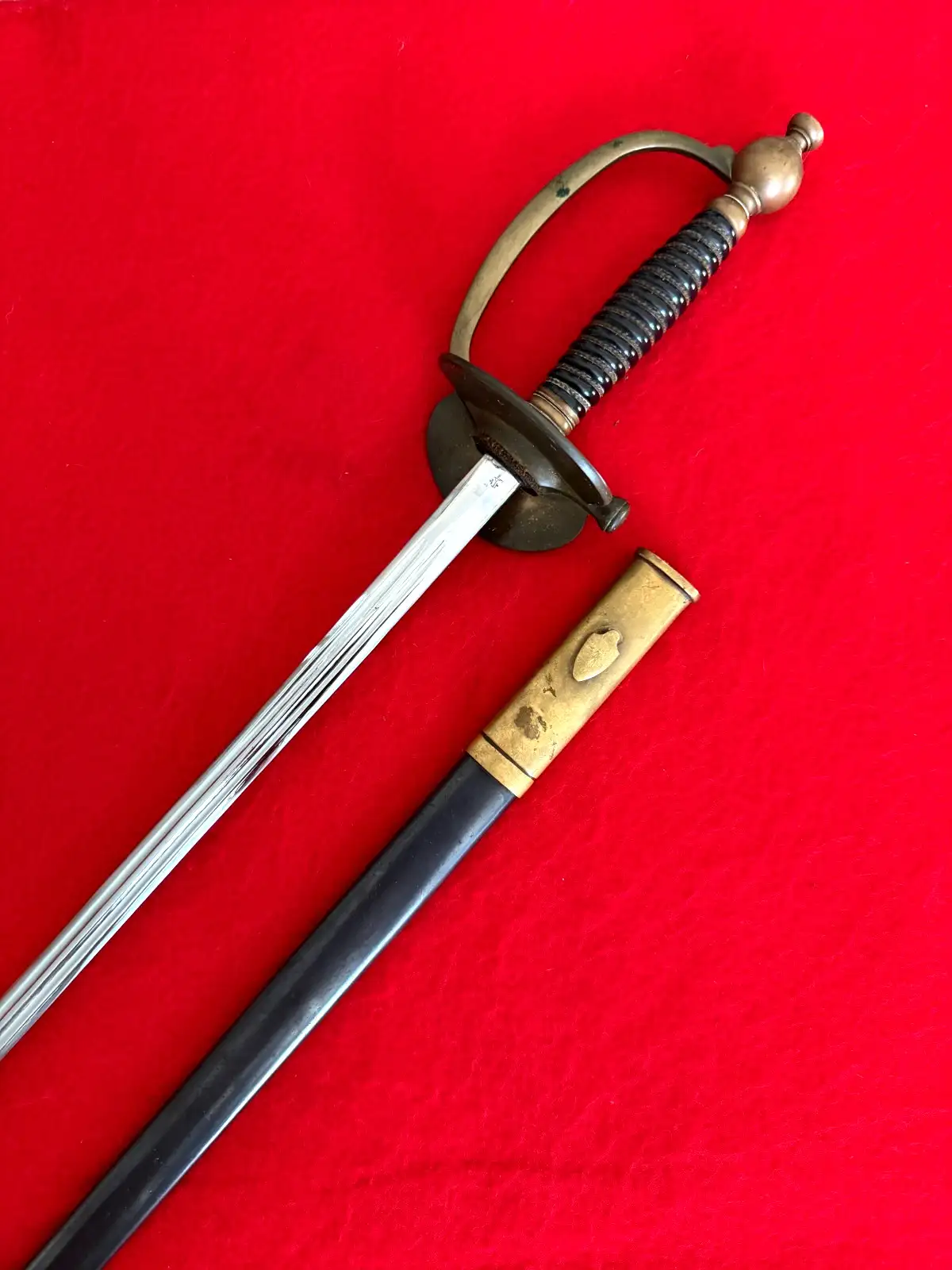
Cast brass, gilt. The pommel is waisted in the diabolo form. A single knuckle bow runs from pommel to guard, plain and faceted along its length, and finishes forward in a flared trumpet quillon.
The clavier — the shell on the outer face — is kidney-shaped, with a raised border, and it is held to the guard by four rivets. Count them there, on the shell, not on the wreath: the wreath is cast into the shell, not pinned to it.
The inner face of the toutes armes and administration version carries a plain counter-clavier that folds on what the French records call the Manceaux system. It latches in the folded position and releases when a sprung steel ball is depressed; on some examples the release presents as a small white-metal button. A counter-clavier that folds loose with no detent has been repaired or replaced. A fixed counter-clavier is a different matter: fixed counter-claviers are recorded on other claviers of the 1872 family, including an engineer example, so a rigid inner plate points toward a different branch version rather than toward damage.
The grip is wood or horn, bound with twisted wire in brass, copper or silver according to who mounted it. The scabbard is steel, nickel-plated on many examples, with a single suspension ring. Dealers who designate examples 'modèle 1872/1884' attribute the 1884 to that scabbard: plated steel with one ring, replacing a more fragile leather scabbard.
Branch and school variants
Read the clavier. The hilt architecture stays constant; the shell changes with the branch and with rank.
Toutes armes and administration take the oak-and-laurel wreath, and on some examples the wreath sits over a fan of six flags. The service de santé takes a serpent on a staff — the rod of Asclepius, described on some examples as a caduceus — inside the same wreath. The génie takes a trophy of engineer arms. Officers of the corps d'état-major of senior rank take a version on a chiselled hilt, foliage and attributes worked into pommel and bow, with an antique helmet over a glaive and six flags among oak and laurel on the shell.
The same sword went to junior officers of the gendarmerie and the Garde républicaine on 11 August 1885, and to agents of the colonial troops commissariat on 12 April 1892, confirmed again on 29 May 1902.
The École polytechnique version replaces the shell's centre with a cuirass and helmet over crossed cannons and a naval anchor between laurel branches, and school blades are found inscribed École Polytechnique on one face — some by Coulaux at Klingenthal, others by the Manufacture Nationale de Châtellerault. Identify it by that emblem and that inscription, because the furniture varies: recorded examples carry both filigreed horn grips with diabolo pommels and dark wood grips cut in transverse fluting with olive pommels and a small terminal button, both folding and fixed counter-claviers, and scabbards in black leather with gilt brass mounts as well as blackened steel with brass mounts. Blades on school examples run from about 70 cm to 80.5 cm.
That sword is the tangente. Polytechnique students have carried an épée since 1830, when the school's part in the Trois Glorieuses won them the right to wear one. It is handed over by a sponsor at the remise des tangentes, and it takes its name from how it hangs — tangent to the red stripes on the uniform trousers. The 1890 Code X puts it plainly: worn on the left, tangent to the stripe, touching the ground.
Klingenthal, Châtellerault, and what a blade marking proves
Blades on this pattern carry Coulaux, or Coulaux & Cie, at the talon, often with Klingenthal, alongside small crowned inspection letters. The Palissy record notes crowned and circled D and B stamps on one example.
Read that marking against the calendar and the deeds. Klingenthal sits in Alsace, which was under German administration from 1871 to 1918 — the pattern's first forty-six years. The state manufacture there was already gone by then. The Coulaux family had run the works as contractors from 1801, and Julien Coulaux bought it at auction in 1836, after which it traded as Coulaux Ainé et Compagnie and then Coulaux et Compagnie. The state's own edged-weapon plant was Châtellerault, founded by royal decree of 14 July 1819 and sited far from the frontier for exactly the reason Klingenthal was abandoned.
So a Klingenthal-marked blade on an M1872 is a private firm's brand on a commercial blade. It is not evidence of state manufacture. A blade on this family marked Manufacture Nationale de Châtellerault is the opposite case and does indicate the state plant — one Polytechnique tangente carries 'Manufacture Nationale de Châtellerault 1909' alongside the school inscription. Hilt and blade did not have to come from the same house, and on private-purchase swords they frequently did not.
Telling it from its neighbours
Against the M1882. The 1882 is a sabre, not an épée, adopted for infantry officers of both junior and senior rank. Its blade is lenticular in section with a single reversed fuller, made in 750, 800, 850 and 900 mm lengths; the regulation guard has four branches in white metal, though private makers mounted three, five, six, seven and nine; the grip is horn. A kidney-shaped shell with a folding counter-clavier is not an 1882. Officers wore the 1882 until it was struck from regulation on 13 August 1925.
Against the M1855 état-major épée. This is the closest rival in form — a straight staff-officer épée with an 870 mm blade, longer than the 1872, worn by marshals, generals, staff officers and senior officers of the engineers and gendarmerie. Its counter-clavier is itself articulated, which is precisely why a folding inner plate settles nothing. The clavier decides it: the 1855 carries the crowned imperial eagle on six flags, the 1872 carries republican devices. Regime iconography, not measurement, is the fast answer here.
Against the M1816 and M1845 engineer épées. The 1816 shell is fixed, the 1845 rear shell is mobile, and the 1855 engineer version has a cuirass and helmet chiselled on the outer half-shell. Engineer blades on these run 800 to 813 mm. None of the three carries the oak-and-laurel wreath with ribbon, and none carries the 1872 engineer trophy — do not confuse the M1845 engineer épée with the modèle 1872 engineer version, which sits on the 1872 hilt.
Against the M1845 sabre. Adjudants and junior officers took a slightly curved blade of 77 cm with two hollow panels and two fullers; senior officers a straight double-edged blade of 86 cm with four hollow panels. A curved blade rules out the 1872 in one glance. The 1855 revision put these on steel scabbards in place of leather, though adjudants kept leather until 1870.
Against the gendarmerie NCO épée of the same year. France fielded a second sword called modèle 1872: the épée de sous-officier de gendarmerie, descended from the modèle 1853 whose clavier had carried an imperial eagle. It has a brass hilt, a straight blade with fullers and hollow panels running from about 78 to 83 cm on recorded examples, and a folding counter-clavier. Two things separate it. Its clavier carries the lictor's fasces on a bundle of flags, not the wreath. And its grip is cast brass, moulded with oak and laurel branches winding upward, where the officer's épée has wood or horn bound with wire. That second point matters, because oak and laurel appear on both swords: the motif alone settles nothing, and only its position does.
What to look for
- A wreath of oak on the left and laurel on the right, tied with a ribbon and cast in relief on a plain ground on the outer shell — the device that separates the all-arms and administration version from every Second Empire épée.
- Four rivets fastening the kidney-shaped clavier to the guard, counted on the shell itself rather than on the wreath.
- A counter-clavier on the inner face that latches in the folded position and releases when a sprung steel ball or small white-metal button is depressed; one that folds loose with no detent has been repaired or replaced.
- A straight double-edged blade with two narrow fullers running roughly the first half of the length; recorded lengths span about 76 to 88 cm, so the measurement rules nothing in or out.
- A diabolo-waisted pommel and a single plain faceted knuckle bow ending forward in a flared trumpet quillon, over a wood or horn grip bound with twisted wire.
- What sits on the clavier, for branch and rank: wreath alone or over six flags (all arms and administration), a serpent on a staff (service de santé), a trophy of engineer arms (génie), an antique helmet over a glaive and six flags on a chiselled hilt (senior corps d'état-major), or a cuirass and helmet over crossed cannons and a naval anchor between laurel branches (École polytechnique).