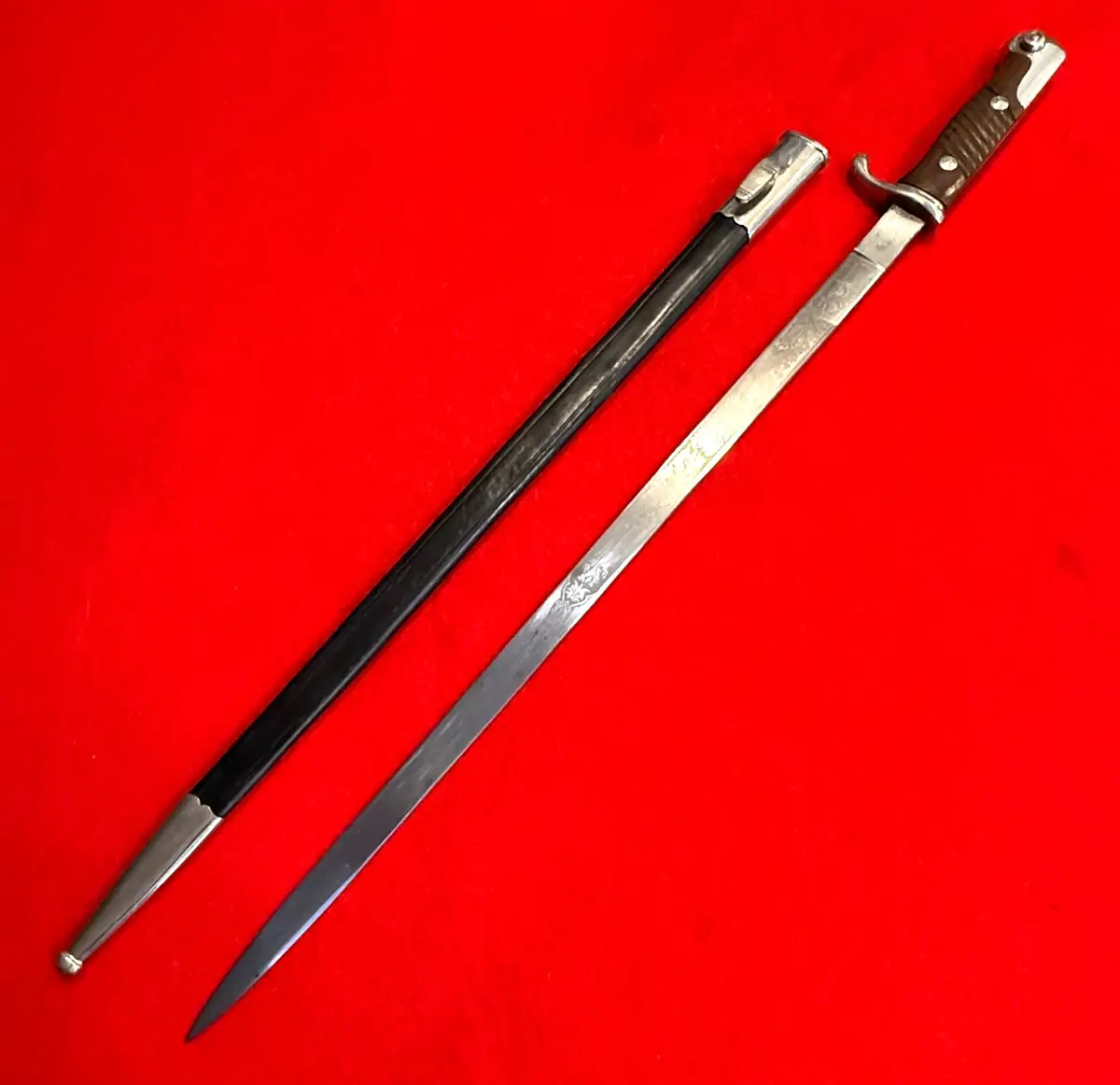
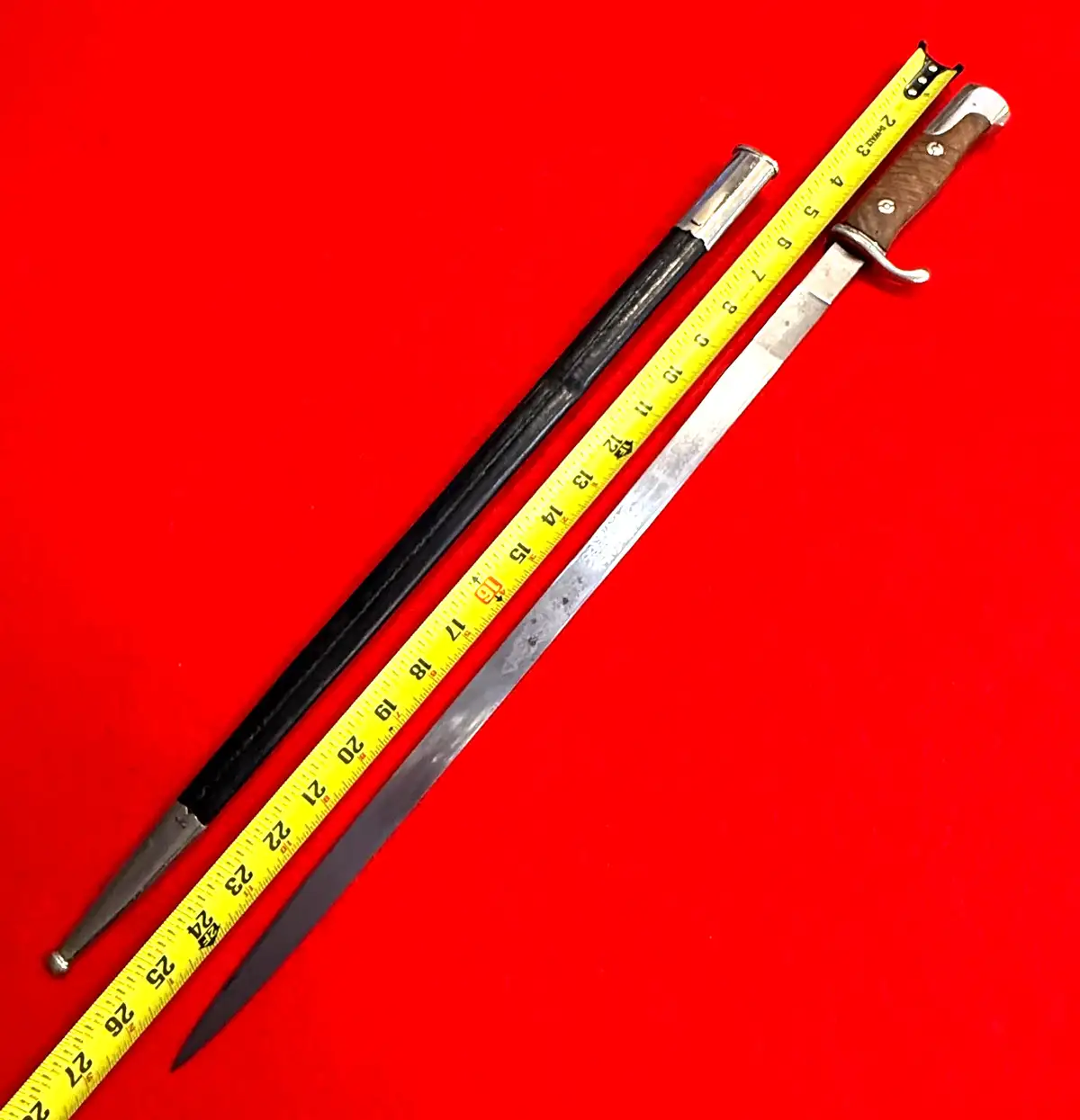
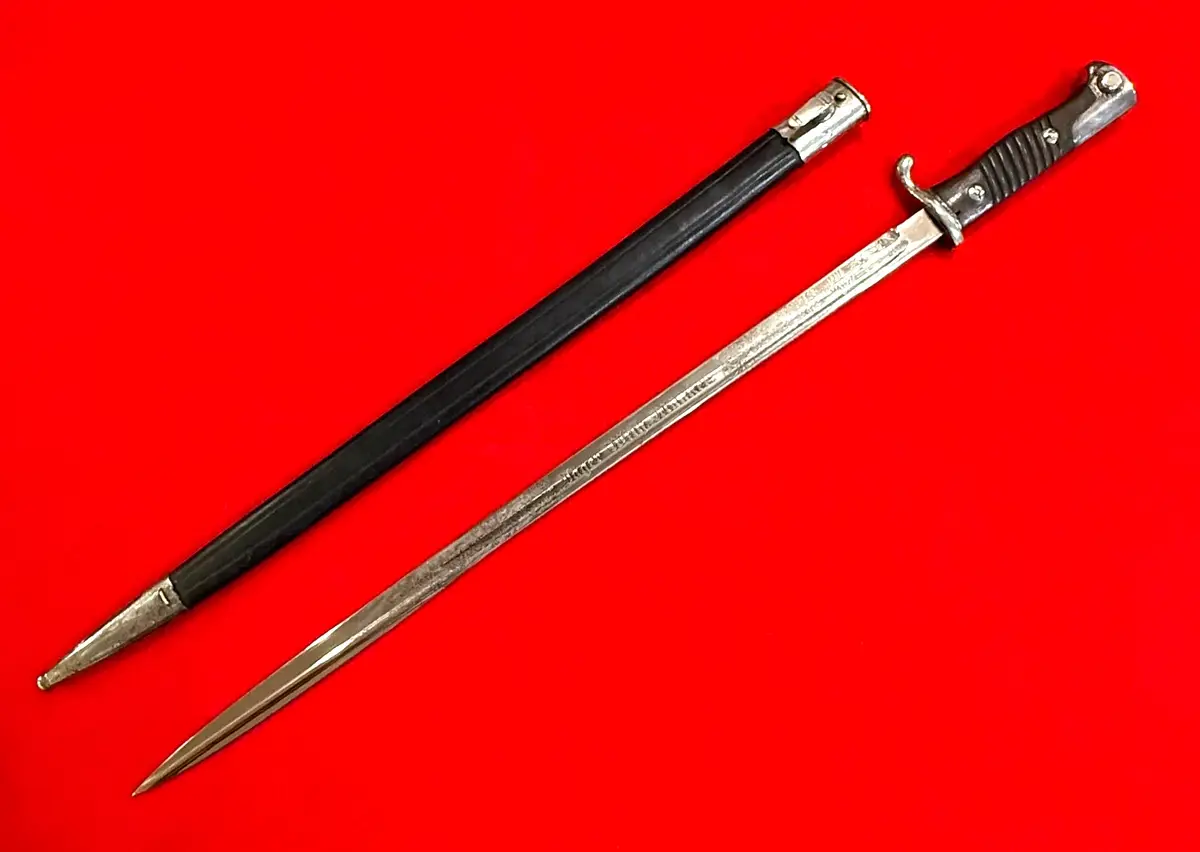
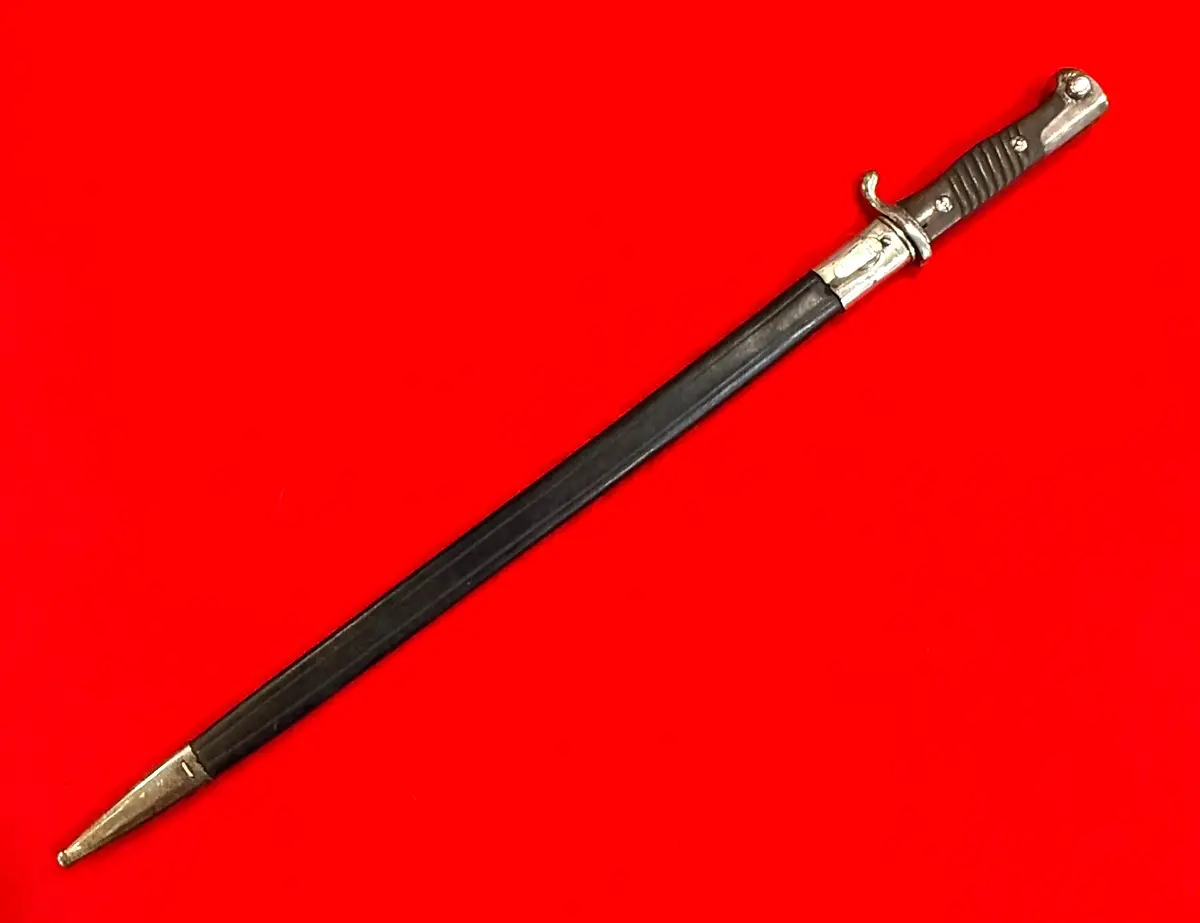
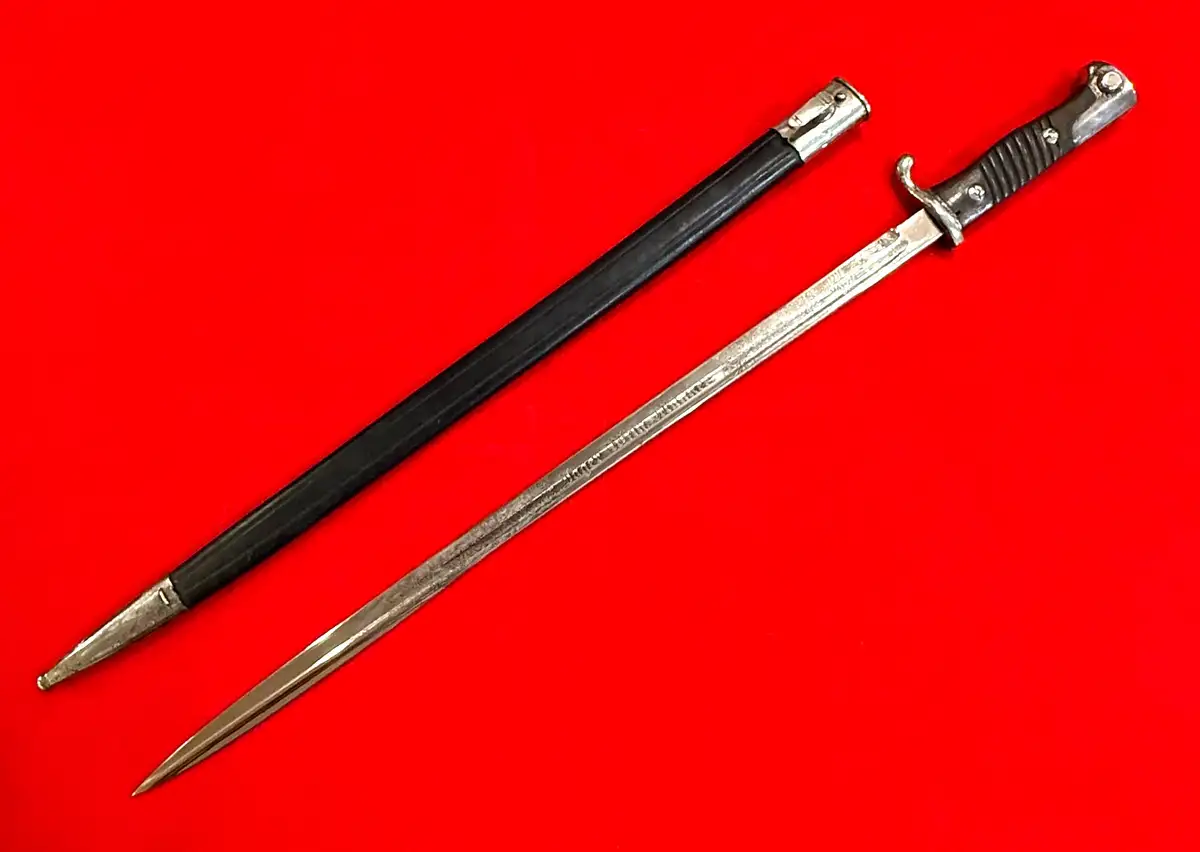
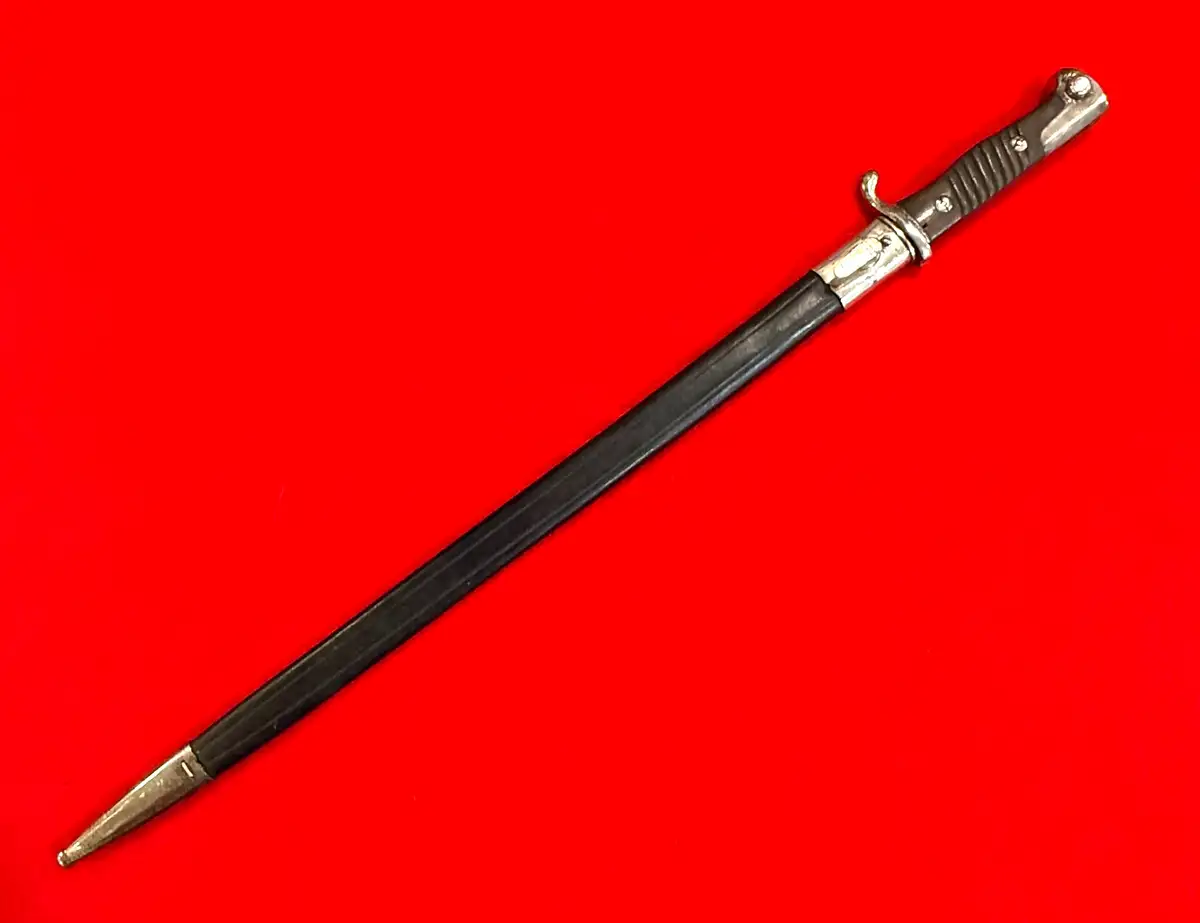
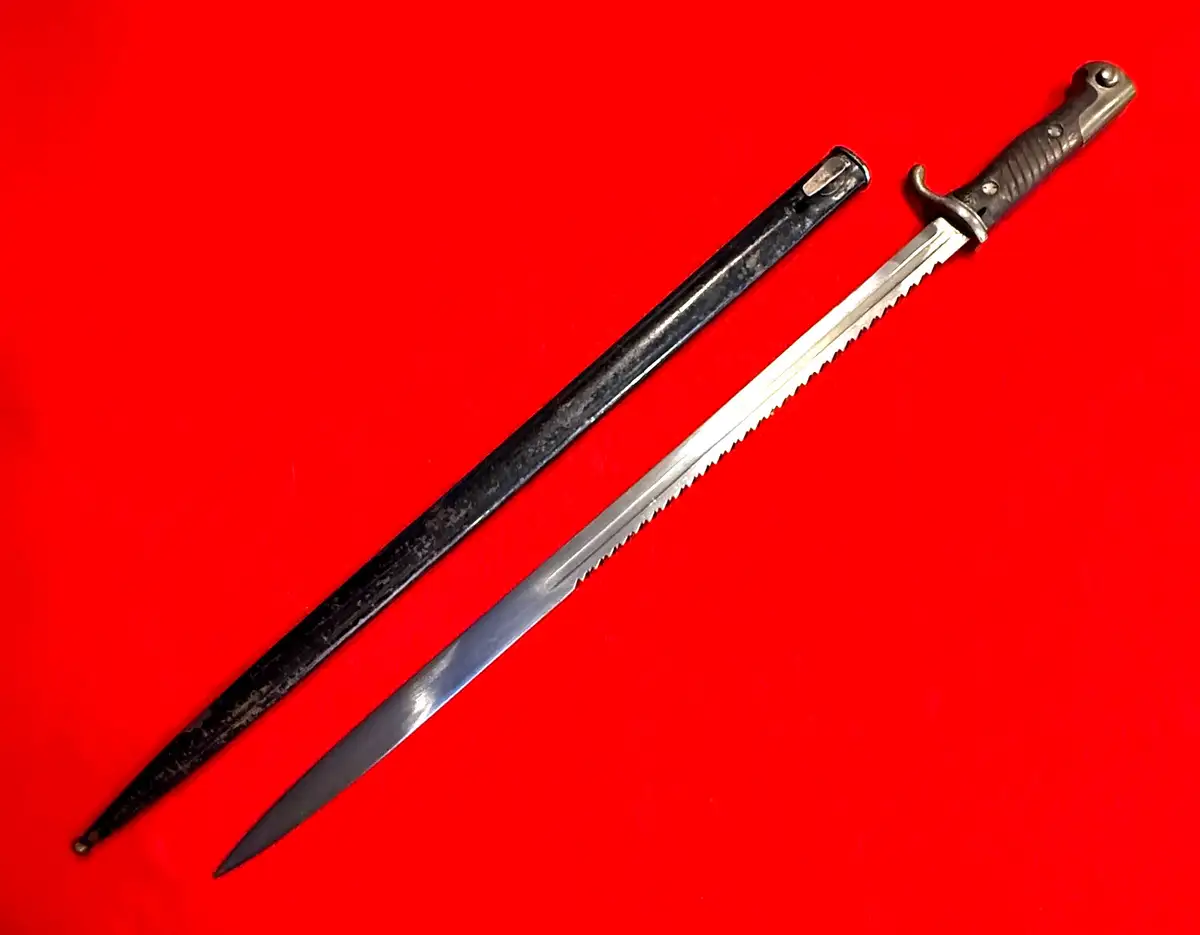
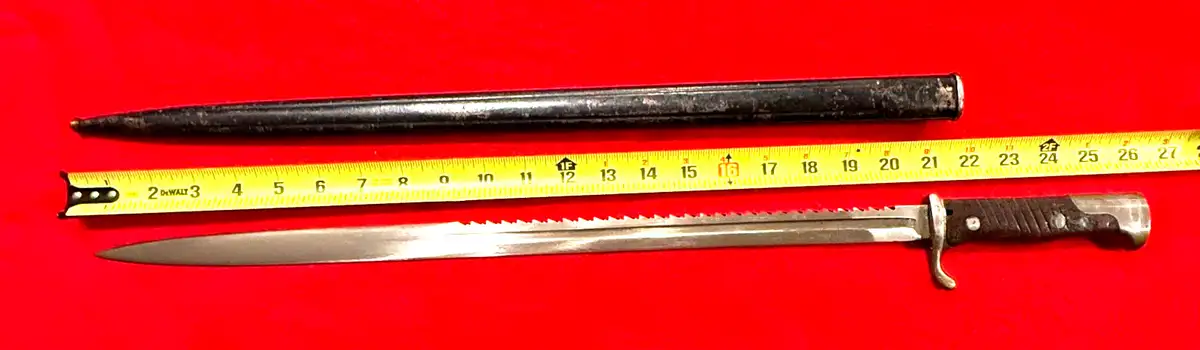
German M1898 Bayonet
Known in the trade as S98.
The Seitengewehr 98 is the long quill-back bayonet issued with the Gewehr 98, and most pieces offered under the name M1898 are one of the shorter German patterns that share its rifle and its mount.
What 1898 specified
Germany adopted the Gewehr 98 in 1898 and gave it a bayonet with no muzzle ring. A T-slot in the pommel rides on a bar fixed under the barrel, and nothing touches the muzzle itself, because a ring alters how the barrel vibrates and shifts the point of impact. Every regulation German bayonet pattern that follows uses that same mount. Wartime substitute bayonets did not, and muzzle rings on them are common.
The blade is what names the pattern. It runs about 520 mm, single-edged, with a rounded rib along the whole spine above one narrow fuller. Collectors call that a quill-back or pipe-back blade, the rib being the quill, and it ends in a short double-edged quill point. Overall length is about 650 mm. The crossguard carries a short quillon that sweeps back toward the grip.
The first grip is a single piece of wood wrapped around the tang and ribbed on the sides. That is the a.A., alte Art. From about 1902 the grip is two wooden slabs bolted through the tang: n.A., neue Art, and this is the version you will meet most often. The changeover was not clean, and a.A. examples dated 1902 exist.
Markings sit in fixed places. The maker goes on the flat of the ricasso. The blade spine carries a crowned royal cypher above the last two digits of the acceptance year; the letter under the crown identifies the state that accepted the piece, so it is not the same letter on every example. Inspection stamps appear on blade and pommel, and unit marks, when they survive, on the crossguard and the scabbard throat.
Why it got shorter
The length was an answer to the French Epee-Baionnette Mle 1886, whose cruciform blade runs about 527 mm. German planners did not want their infantry outreached and specified a blade to match. The reach cost them everything else: half a metre of thin quill-back blade is slender for its length, and the answer when it came was a shorter, sturdier one.
The Seitengewehr 98/02 came first, and it was not a general infantry pattern. It is a pioneer and machine-gun-crew bayonet with a blade about 44 cm long and about 1.25 inches wide at the crossguard, heavily toothed along the back to within three inches of the point. It is a broad, massive blade with no quill rib at all. It did not last: the Seitengewehr 98/05 replaced it for engineer and pioneer troops in late 1905 because the 98/02 was judged too long and heavy for the work. The S98 itself was not withdrawn, and it was still standard long-bayonet issue at the outbreak of war in 1914.
Prussia introduced the S98/05 in late 1905, blade about 368 mm, overall about 502 mm, broad-backed and widening toward the point, the shape that earned it the name Butcher. It has two forms and the difference is visible from a metre away. The first has tall vestigial lugs where a muzzle ring would sit, which collectors call high ears, and no flashguard. From 1915 a steel flashguard was fitted along the back of the hilt to shield the grips, the ears were cut down, and the leather-bodied scabbard gave way to an all-steel one; that second form is the S98/05 n.A. The reason was the Karabiner 98: its shorter barrel put the muzzle blast against the wooden grips and charred them. The two changes do not always travel together, and 1915 transitional pieces exist with high ears and a flashguard, or low ears and none.
Treat the flashguard as a date, not a pattern. It spread across wood-gripped German bayonets from 1915 onward, so it tells you when a piece was made or reworked, not which model you are holding.
The sawback, and what it was for
A minority of blades were made with saw teeth cut into the spine, the Saegeruecken, designated m.S. for mit Saege against o.S. for the plain back. The regulation saw on the 98/05 is described as 29 double teeth. The commonly quoted proportion of sawback production is about six per cent. Sawbacks were made on the long S98 as well, so the feature is not confined to the shorter patterns.
The saw was a tool. Pioneer and engineer units cut brush, firewood, revetting timber and the wooden stakes that carried wire. Sawbacks also reached machine gun crews, non-commissioned officers and, in small numbers, ordinary infantry.
The myth ran the other way. Allied propaganda presented the sawback as an instrument designed to tear, and rumours circulated that captured men carrying one would be shot. German official inquiries in July 1915 and April 1917 looked for evidence of such killings and did not find it. The rumour spread anyway, and it spread among German soldiers, which is what mattered.
An order of 16 September 1917 withdrew sawback bayonets from front-line formations. A further order of 6 January 1918 had the teeth ground off blades in hand, and reworked pieces were designated S.Abg., Saege abgeschliffen. That is why so many surviving blades show a back that is flat but narrower than a factory plain spine, with abrasion marks and a re-blued or bare strip along it, sometimes with the S.Abg. stamp. Collectors call these sanitised. Narrowing plus grinding marks is the evidence, since a plain blade that has been polished or shortened can also show work along the back.
Ersatz and dress
From 1915 German workshops turned out substitute bayonets, Ersatzseitengewehre, because regulation production could not equip a mobilised army. Most are all-steel: a pressed or cast one-piece hilt, no wood, a plain blade. The German specification called for a blade of about 12 inches; shortened examples of around 10 inches usually indicate later Turkish service. Muzzle rings are common, some cut in two stages so that one bayonet fitted both the Gewehr 88 and the Gewehr 98. Anthony Carter catalogued 79 German types in 1976 and his numbers remain the way collectors refer to them. An ersatz is not a variant of the S98; it is a different object built to do the same job.
Dress bayonets are a separate trade. An Extraseitengewehr was bought by the soldier, not issued, and worn with walking-out and parade dress. Blades run roughly 8 to 10 inches, blade and fittings are nickel plated, grips are wood, stag or imitation stag, and the blade is often etched with an eagle or a service-time motto. Pommels are frequently eagle-headed. The mounting hardware is decoration: the pommel slot is shallow or absent and the press stud releases nothing.
That trade continued after 1933 and expanded sharply. Solingen firms, Eickhorn and Klaas among them, sold kS98-pattern dress bayonets to Wehrmacht and police personnel through the Nazi period, with blades etched with the national eagle and swastika. They are dress items of that state. They were never service bayonets and were never meant to fit a rifle.
Telling it from its neighbours
Against the S98/05: length and profile settle it. The S98 blade is about 520 mm, slender, with a raised rib down the spine. The 98/05 blade is about 368 mm, flat or toothed along the back, and widens toward the point. Nothing about a 98/05 is slender. If the listing says M1898 and the photograph shows a cleaver, it is a 98/05.
Against the S98/02: this is the pioneer pattern, blade about 44 cm and about 1.25 inches wide at the guard, with heavy teeth running almost to the point. It is shorter than an S98 and far broader, and it has no quill rib. It is rare, and it is more often confused with the 98/05 than with the S98.
Against the kS98: the Kurzes Seitengewehr 98 is a short bayonet with a blade of about 250 mm. Prussia introduced it on 30 April 1901 as a sidearm for the independent machine gun detachments and renamed it kS98 on 23 February 1905. It shares the bar mount with the S98, and the pommel is where they part: the kS98 carries a stylised eagle's head with a beak, borrowed from the older Jaeger hunting sidearms, while the S98 pommel is plain. If the hilt ends in a beak, it is not an S98. The earliest examples have riveted leather grips and were made only at Erfurt between 1901 and 1912; wood and composition grips on two bolts follow from 1912. Published production is around 32,000, which makes it an uncommon imperial pattern.
Against the S84/98 III: this is the Karabiner 98k bayonet, blade about 252 mm, overall about 385 mm, flat spine, a small flashguard, and a straight crossguard with no quillon. Grips are wood in 1935-36 and again in 1945, bakelite for most of the years between. It was adopted with the Karabiner 98k and made from the mid-1930s to 1945, so it belongs to the Nazi period and not to either imperial pattern. Sellers call it the K98 bayonet. It is not an M1898 of any kind.
Against dress bayonets: put the pommel slot under a light. On a service piece the mortise is a full-depth channel and the catch grips a bar. On a dress piece the slot is shallow or blind and the stud moves without locking anything. Add nickel plating over blade and fittings, an etched panel, and stag grips, and you have a walking-out item being sold as issue.
What to look for
- A raised rounded rib running the full length of the blade spine above a single narrow fuller, ending in a short double-edged point: the quill-back profile of the long S98. Neither the 98/02 nor the 98/05 carries it.
- Measure the blade from the shoulder where it leaves the crossguard, not from the front of the guard: about 520 mm puts you on an S98, about 440 mm on an S98/02, about 368 mm on an S98/05, about 250 mm on a kS98 or an S84/98 III.
- A crowned cypher followed by two digits on the blade spine: the acceptance mark and the year. The letter under the crown varies with the accepting state, so read it rather than assuming it. The maker's name or trademark sits separately on the flat of the ricasso.
- Whether the grip is one piece of ribbed wood wrapped around the tang (a.A.) or two slabs bolted through it (n.A., from about 1902), remembering that a.A. pieces dated 1902 exist.
- The pommel: plain on an S98, a stylised eagle's head with a beak on a kS98. This separates the two hilts faster than any measurement.
- A spine that is flat but noticeably narrower than the rest of the blade back, with abrasion marks along it and sometimes an S.Abg. stamp: a sawback whose teeth were ground off under the 1917 and 1918 orders.