Toledo
Toledo had no single sword factory until 1761, which is why the city's name on a blade is a claim rather than a provenance.
A city of marks, not a workshop
In 1762 Francisco Javier de Santiago Palomares drew and engraved a plate at Toledo reproducing 99 armourers' marks, each set beside the name of the swordsmith who used it. It remains the principal documentary reference for Toledo sword marks, and museums still cite it by number: the Wallace Collection identifies one blade's mark as no. 54 in Palomares's list.
What the plate records is a guild, not a factory. Toledo made blades in independent shops, and each shop had its own punch, driven into the ricasso — the unsharpened flat just above the guard.
Sebastián Hernández used a crowned Z. Julián del Rey used a small stylised quadruped that collectors call the perrillo, the little dog; on surviving blades it appears struck into the steel and filled with copper, so it reads bright against a darker surface. Del Rey is counted among the Toledo makers, but he is also recorded working at Zaragoza, around the turn of the sixteenth century.
Look at the ricasso first. Lettering along the blade face is decoration, and decoration is the easiest thing on a sword to add later.
The name outran the city
Toledo names travelled further than Toledo blades. The Wallace Collection's rapier A669 carries a blade of about 1570–1600 inscribed SAHAGVN EL VIEIO with the crowned S of Alonso de Sahagun the elder, a Toledo bladesmith of the later sixteenth century. The catalogue records the blade as Spanish (Toledo) or a German imitation, and does not choose between them.
Not all of that copying was fraud. Of Tomás de Ayala, the Wallace catalogue says most blades bearing his name cannot have come from his hand, and that his is one of those names used "as a kind of trade label, indicative of a certain type of blade" rather than to deceive. It was still being applied to blades in the eighteenth century. There was also more than one man of the name: a Tomás de Ayala died in 1583, and another appears to have been alive in 1625.
The Wallace Collection's cup-hilt rapier A656, probably of the third quarter of the seventeenth century, shows how little a matching mark settles. Its ricasso mark corresponds with the one Palomares gives for Juanes de Tolledo, no. 54 in the list. The catalogue doubts it anyway: the mark was cut with a chisel instead of stamped, the lettering of the blade is not the usual Spanish form, and the inscription on the forte spells the maker's name with a doubled L — JVANEZ DE TOLLEDO. The chiselling on the cup is separately judged poor and probably a nineteenth-century addition.
A mark that matches the book proves nothing on its own. A mark made the right way, in the right place, is where the argument starts.
Charles III starts again
The factory began working in 1761, in the old Casa de la Moneda — the mint — on what is now Calle Núñez de Arce. In its first phase it made three kinds of sword: cavalry, dragoon and infantry.
To organise it the crown brought in Luis Calisto, a master from Valencia, whose task was to gather the city's scattered bladesmiths into one works. The skill had to be imported into the city that was famous for it.
In 1777 the crown began planning a move outside the walls, to the Tagus bank at the place called playa de las Barcas, where the river could drive the machinery. Francesco Sabatini designed the main building, over earlier plans by the military engineers Luis de Urbina and Felipe Gazola. The works were finished in 1780 and production began in 1782.
What Sabatini built looks like a palace: a rectangular plan in two blocks, each with a large courtyard, rusticated pilasters framing the openings, and a chapel dedicated to Santa Bárbara, patroness of the artillery.
What factory blades say about themselves
From the last third of the nineteenth century the works added cartridge shops. It was renamed Fábrica Nacional de Toledo in 1910, and a hydroelectric plant in neo-Mudéjar style opened at Azumel in 1917 to power the site. The factory began to go obsolete from the 1960s and closed for good in 1996. The Ministry of Defence sold the land and buildings to the city in 1998, and the complex has held the technological campus of the University of Castilla-La Mancha since that year.
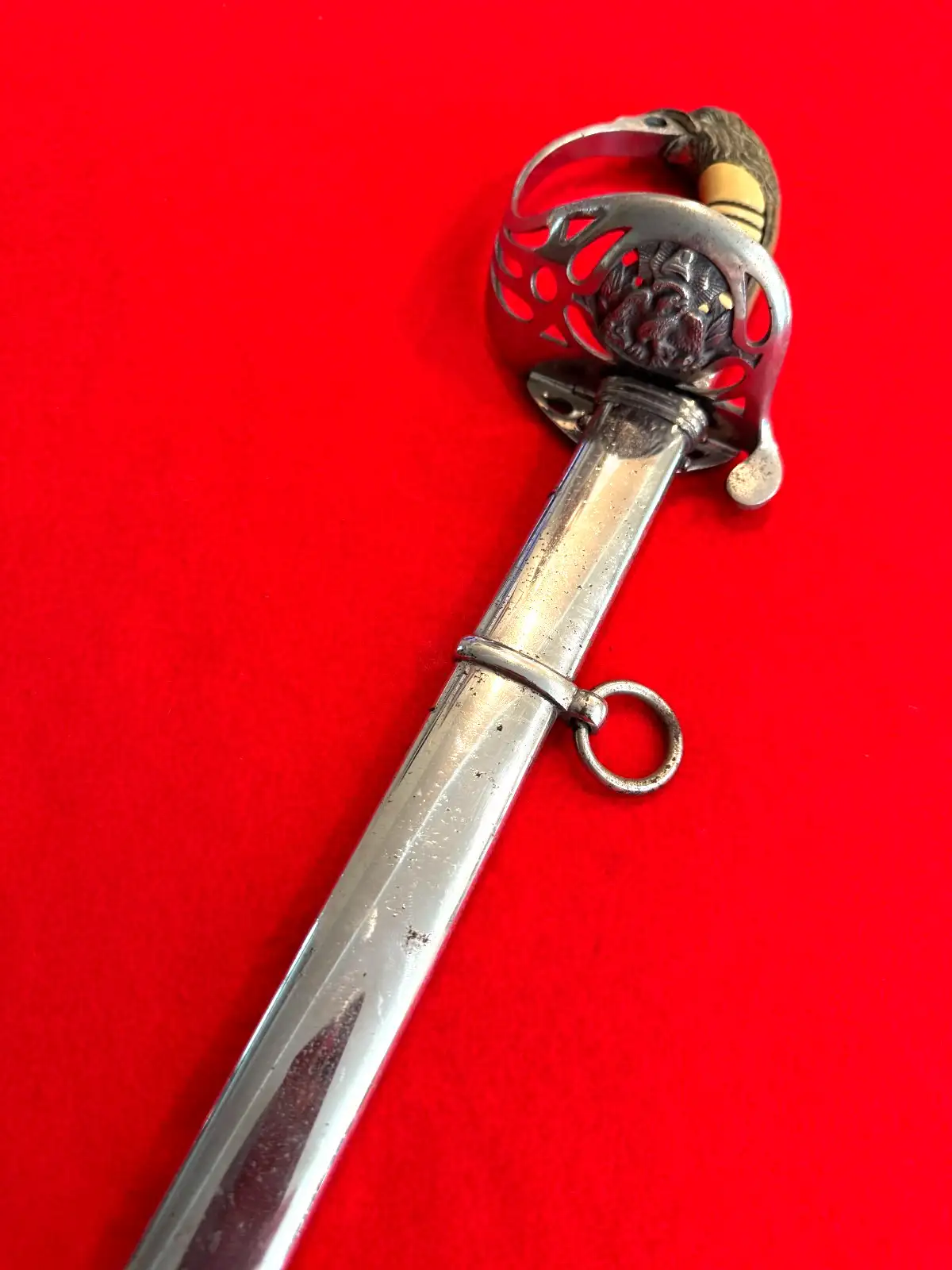
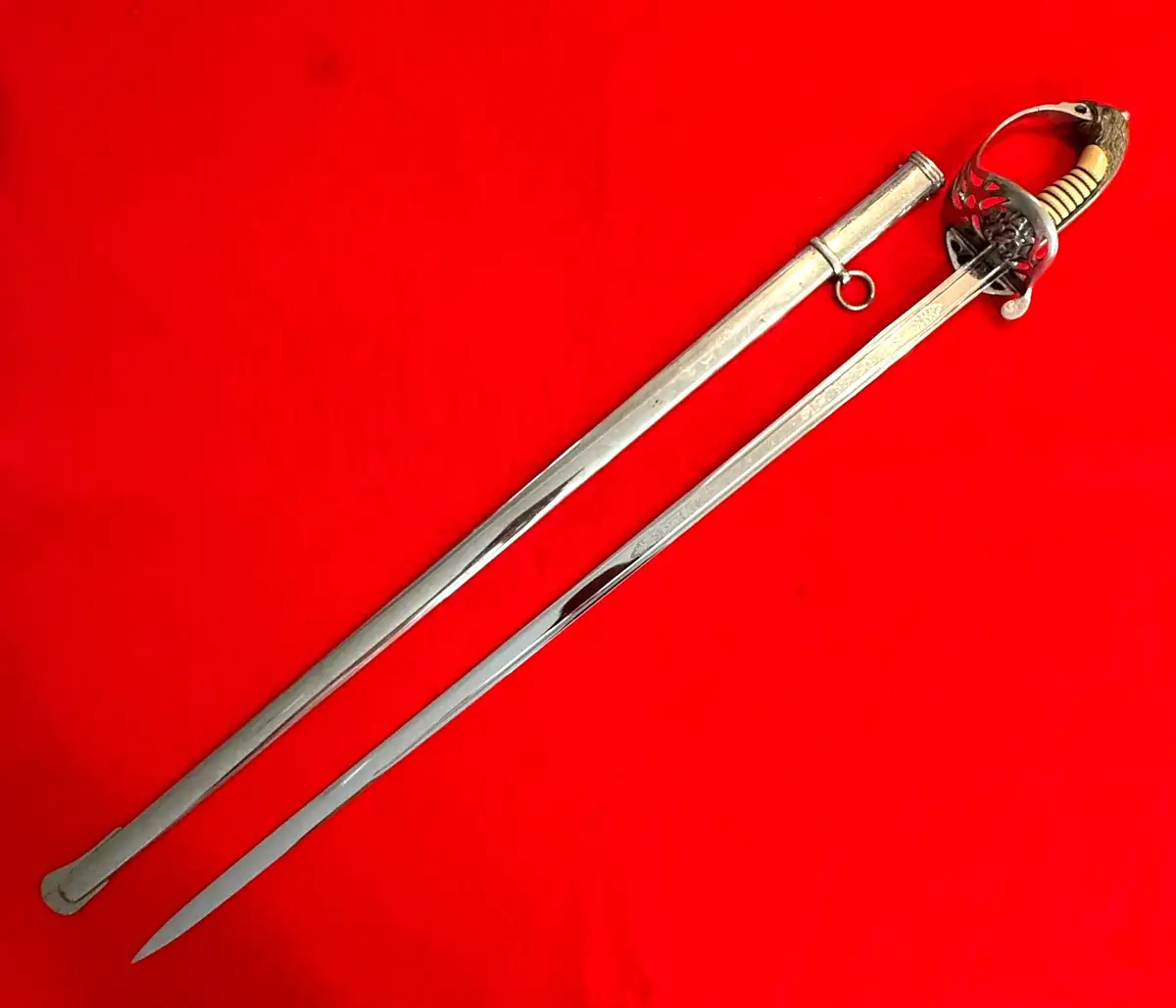
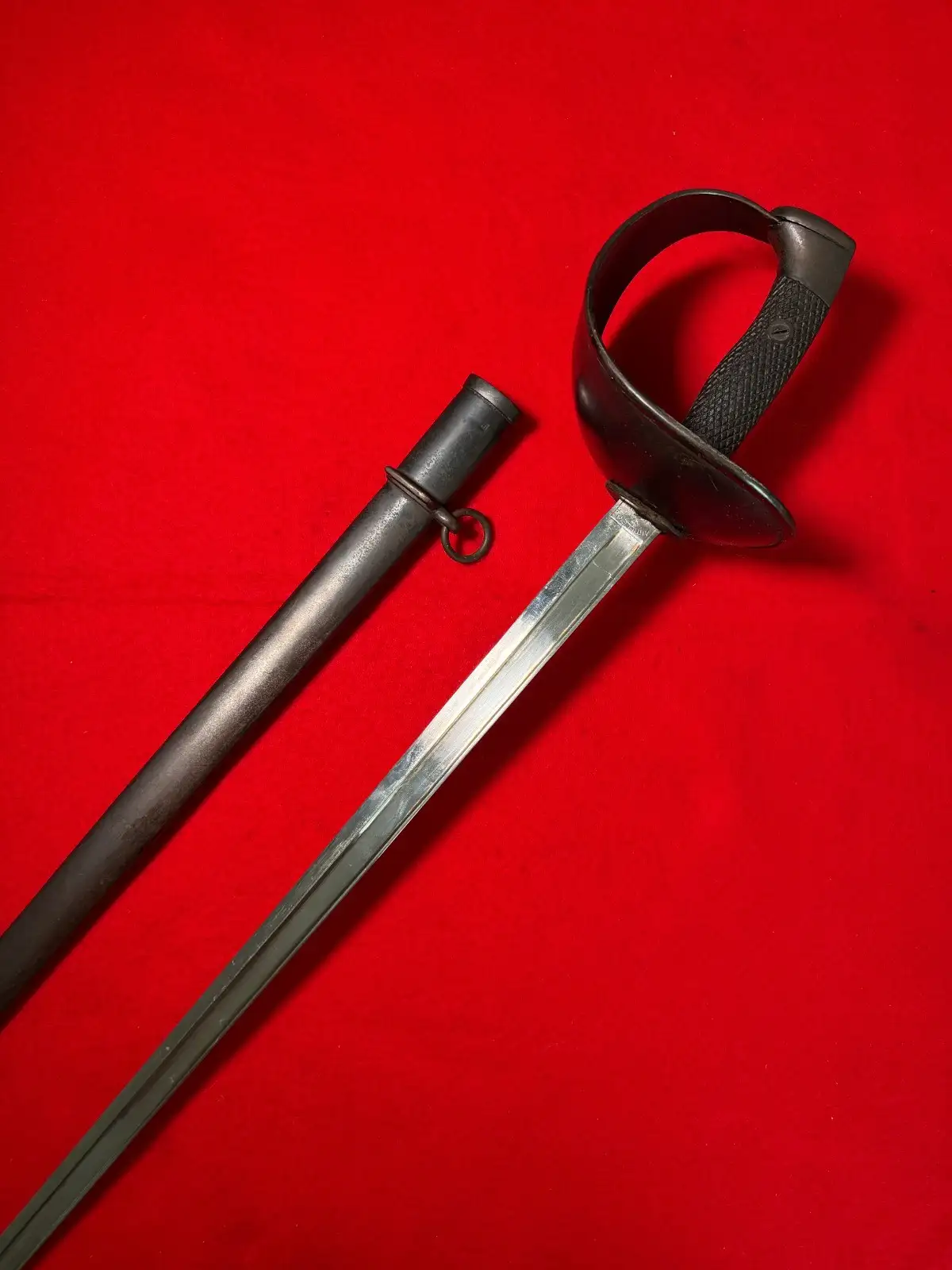
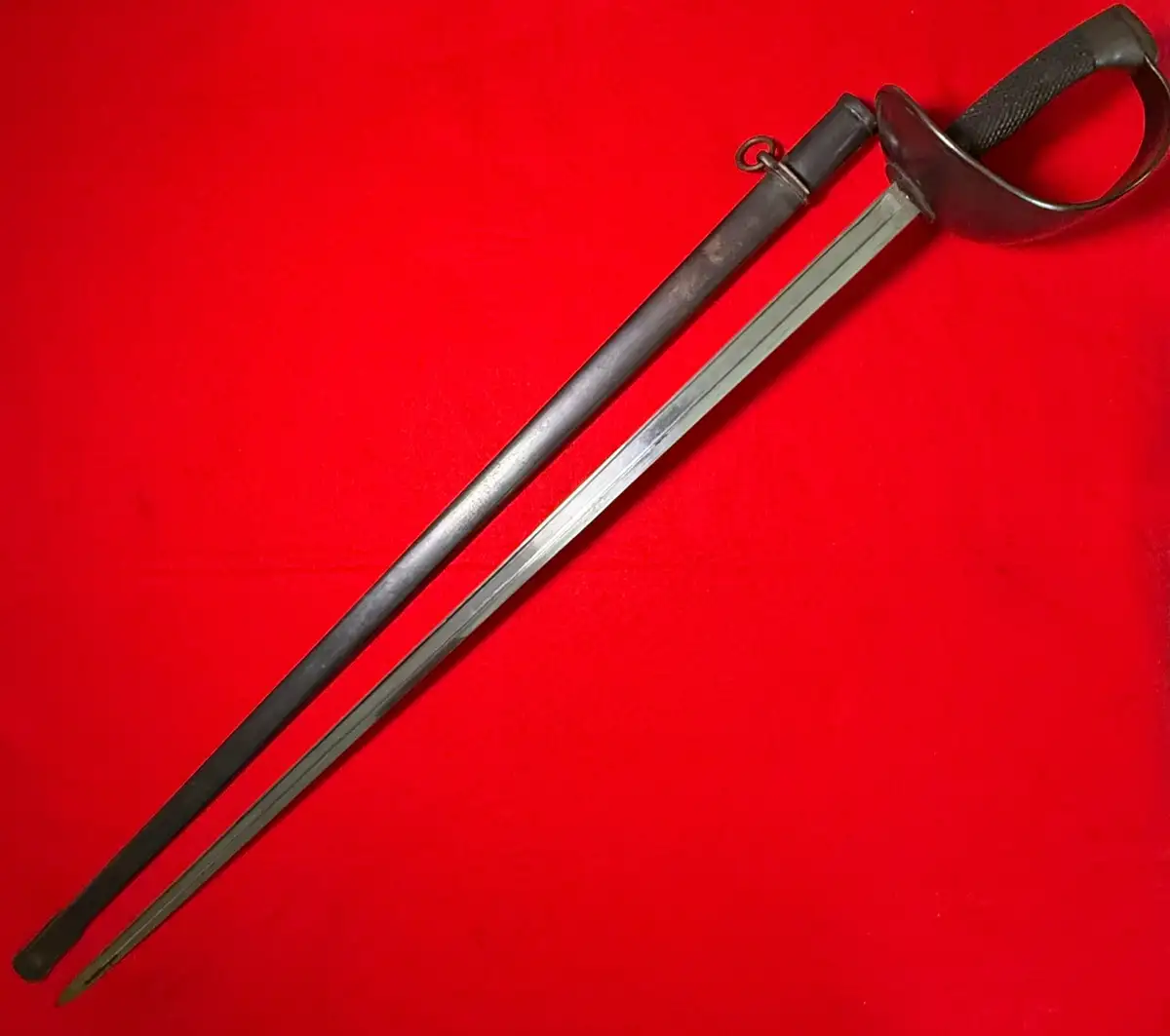
State factory blades name themselves and date themselves. On the ricasso you will find a form of the factory's name — Fábrica de Toledo, Artillería Fábrica de Toledo, Fábrica Nacional de Toledo — with a year of manufacture.
The year is the strongest single piece of evidence on a Spanish regulation sword. Dates of 1893, 1895 and 1896 recur, because those are the years that armed Spain for Cuba, Puerto Rico and the Philippines, and swords of those years are common in the American market as a result of the war that followed in 1898.
Inscriptions do not always sit in the same place across the nineteenth century. A mark somewhere other than where you expected it is not, for that reason alone, wrong.
Damascene, and the second Toledo
Damascene work — gold and silver inlaid into dark steel — is usually traced in Spain to the Islamic period, and Toledo became the major European centre for it. Under the Habsburgs the city's inlaid arms and armour sold across Europe. The trade fell away in the eighteenth century.
It revived in the nineteenth on different goods. Travellers wanted something they could carry, and Toledo workshops turned the technique onto boxes, brooches, tie pins and scissors in Moorish patterns. By the twentieth century damascene was the thing you bought in Toledo. It is a living craft, and it is also why the city's name is now attached to a large volume of decorative metalwork that has nothing to do with weapons.
The modern sword trade sits on the same ground. Working forges remain in the city, and around them is a much larger business in display pieces and letter openers: stainless blades, plated fittings, and famous names — Tizona, Colada — applied to objects made to hang on a wall.
What the name proves
Before 1761, a Toledo blade is identified by the punch and how it was struck, by the blade's section and grind, and by the fittings — not by the city name. Between the guild and the Royal Factory lie generations of German work wearing Spanish signatures, some of it sold as a grade of blade rather than as a lie.
After 1761 the name arrives with an institution, a year and a paper trail, which is why nineteenth-century Spanish regulation swords are among the easier antique blades to place.
The word Toledo tells you a claim was made. How the mark was made tells you whether the claim is worth anything.
What to look for
- The ricasso — the unsharpened flat between guard and edge — is where a maker's punch belongs; the mark should be struck into the steel, displacing metal, rather than chiselled or engraved into it.
- Julián del Rey's perrillo is a small stylised quadruped; on surviving blades it is struck and filled with copper, so on an unpolished surface it reads as a bright figure against darker steel.
- Sebastián Hernández used a crowned Z, but there were an elder and a younger swordsmith of that name, so the mark alone does not fix a generation.
- On Royal Factory production, look for a year of manufacture stamped beside the factory name; 1893, 1895 and 1896 are common, being the years Spain armed for Cuba, Puerto Rico and the Philippines.
- The factory's name changes across its life — Fábrica de Toledo, Artillería Fábrica de Toledo, and Fábrica Nacional de Toledo from 1910 — so the wording narrows the date range before you read the year.
- Check the spelling and letterforms of any Spanish inscription. The Wallace Collection's cup-hilt rapier A656 carries a ricasso mark corresponding to Palomares, but its blade inscription doubles the L in Toledo and the mark is chiselled rather than struck; the catalogue treats both as grounds for doubt.