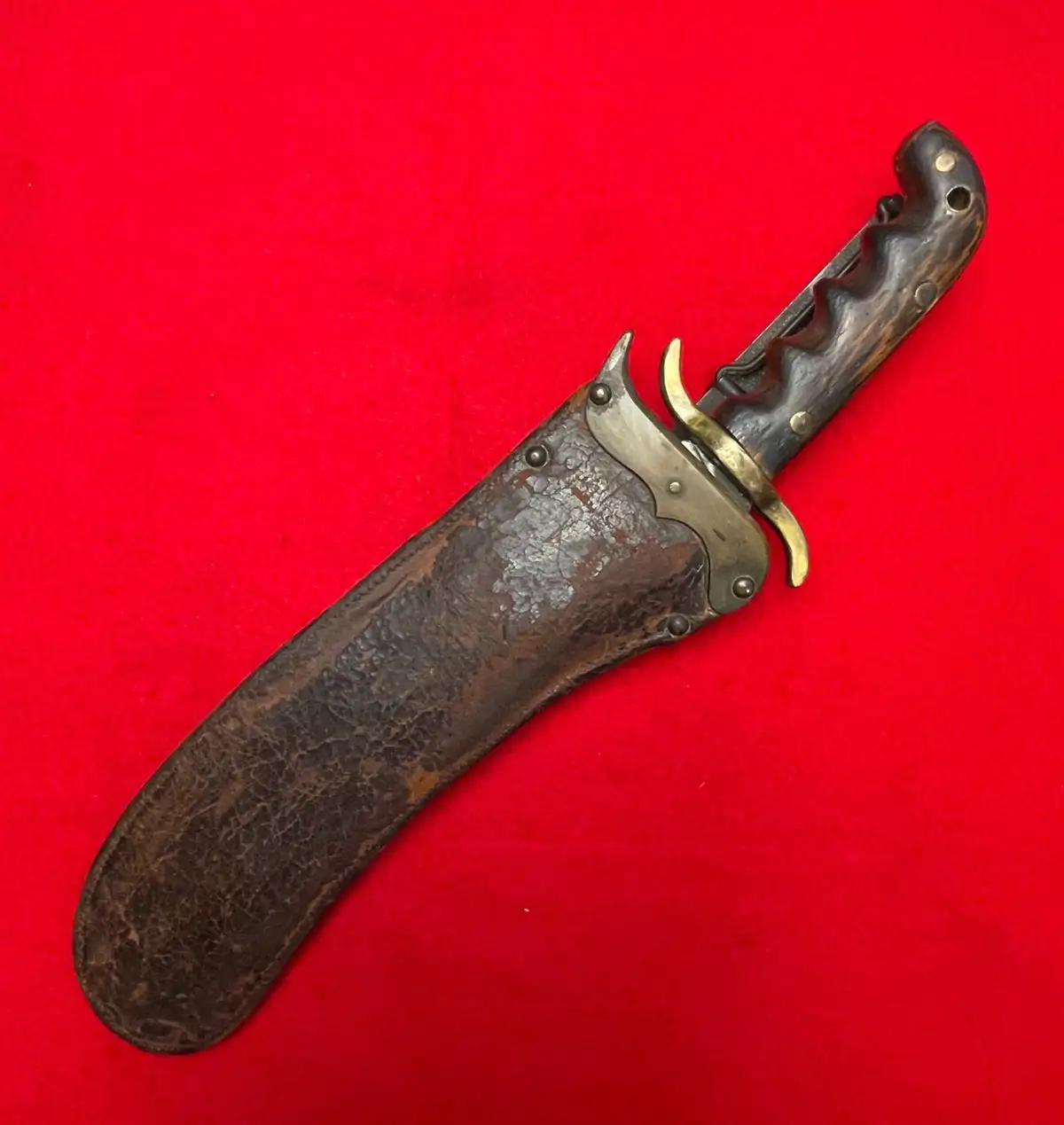
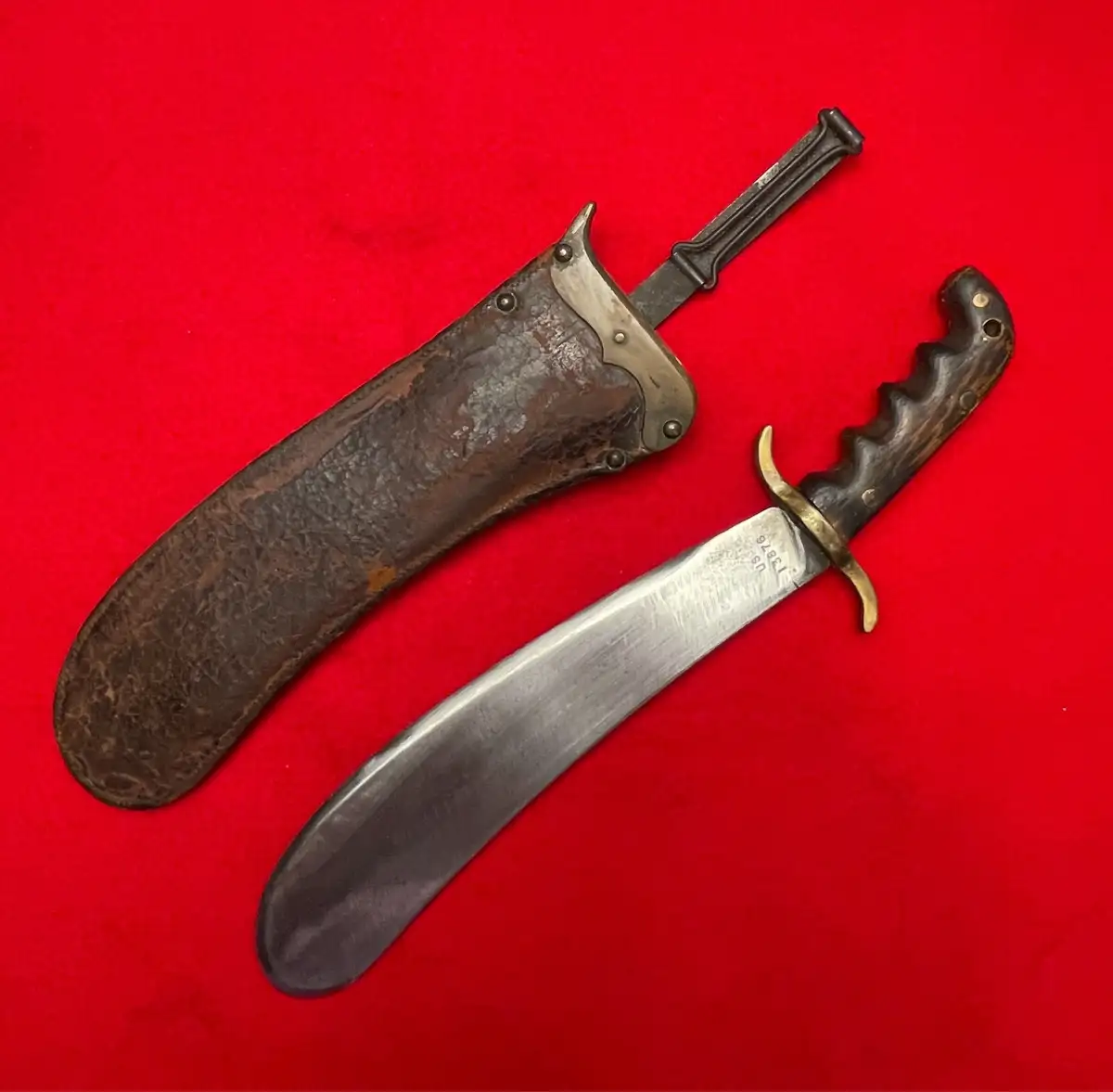
US M1904 Hospital Corps Knife
Known in the trade as M1904.
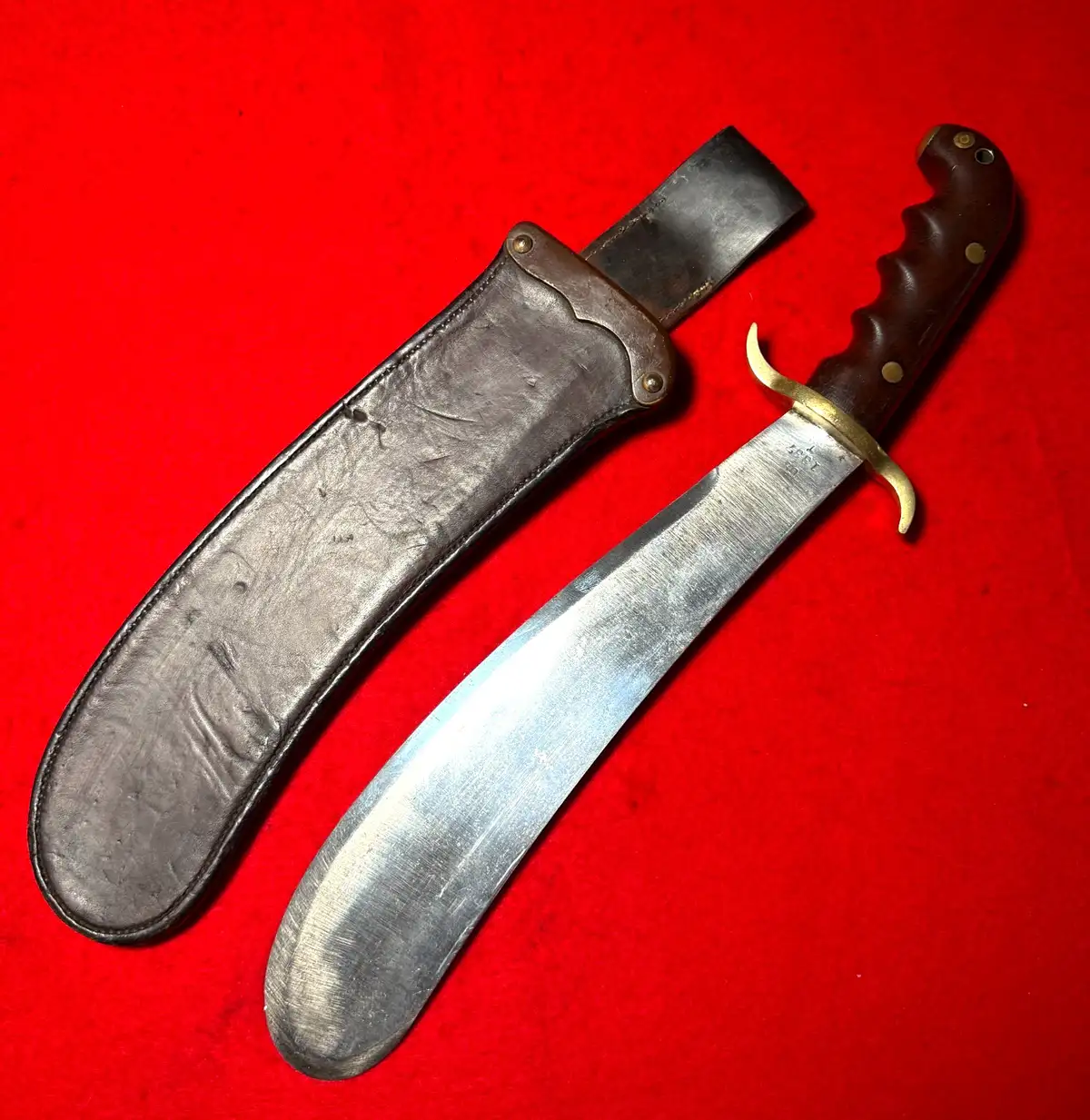
A 12-inch chopping blade with a curved back and a rounded tip, made at Springfield Armory from 1904 to 1914 for enlisted medical men.
A blade for men who carried no rifle
The Hospital Corps was created by act of Congress on 1 March 1887 as the Army's enlisted medical branch. General Order 29 of April 1887 set out what it was for: hospital stewards, acting hospital stewards and privates, permanently attached to the Medical Department, performing hospital and ambulance service in garrison, camp and field. What those men needed in the field was a tool that would open a litter route through brush, cut poles for an improvised stretcher, and split a branch into a splint.
Springfield Armory's first answer was the Model 1887 Hospital Corps knife, a thin-bladed piece built in tiny numbers: 650 in 1889 and 406 in 1891, 1,056 in total. The Model 1904 replaced it with something far heavier.
The M1904 was not designed for field amputations. That story attaches itself to Hospital Corps knife listings and has no documentary basis; Springfield Edge addresses it directly as a myth. The blade is a utility chopper and its geometry says so — three-eighths of an inch thick at the spine, a single-bevel edge, and a tip with no point on it at all.
What the pattern specifies
Blade: 12 inches, with a heavy curved back and a cutting edge that swells into a deep belly before closing to a rounded tip. The back profile matters, because the M1909 bolo beside it has a straight back. Width at the ricasso is about 1 3/8 inch on measured examples. Published widths at the belly run from 2 inches to 2.5 inches. Spine thickness is 3/8 inch. Overall length is quoted as 17 inches and as 17.25 inches.
Measure the blade from the shoulder where the steel meets the guard, and note which point a listing used before comparing its figure with the 12-inch reference.
Hilt: a brass crossguard in a shallow S-curve, about 4.25 inches across the ends on a measured example. Two walnut grip scales with four finger grooves, held by three large brass rivets. A brass pommel cap curves back over the butt and is drilled for a lanyard. The brass guard is the material check that separates this pattern from the M1909; the brass pommel cap is not, because the M1909 has one too.
Springfield Armory and the serial number
Production ran at Springfield Armory from 1904 to 1914 and totalled over 40,000. The M1904 was the first modern Springfield edged weapon to carry a serial number.
The numbering has a specific origin. The first 236 knives went out unnumbered. At the request of the Surgeon General, the Armory began numbering at 237 and ran upward from there; the lowest serial actually recorded on a surviving knife is 264. Serials in the high thirty-thousands appear on 1914-dated blades — a Horse Soldier example dated 1914 carries 38893 — which is what a run of that size predicts.
Markings sit on the ricasso, split across the two faces. On the obverse: U.S. over the serial number. On the reverse, in three stacked lines: S A, a flaming ordnance bomb, and the year. Read the year on the reverse and the number on the obverse. A blade whose date falls outside 1904 to 1914 is not what it is being called.
The scabbard
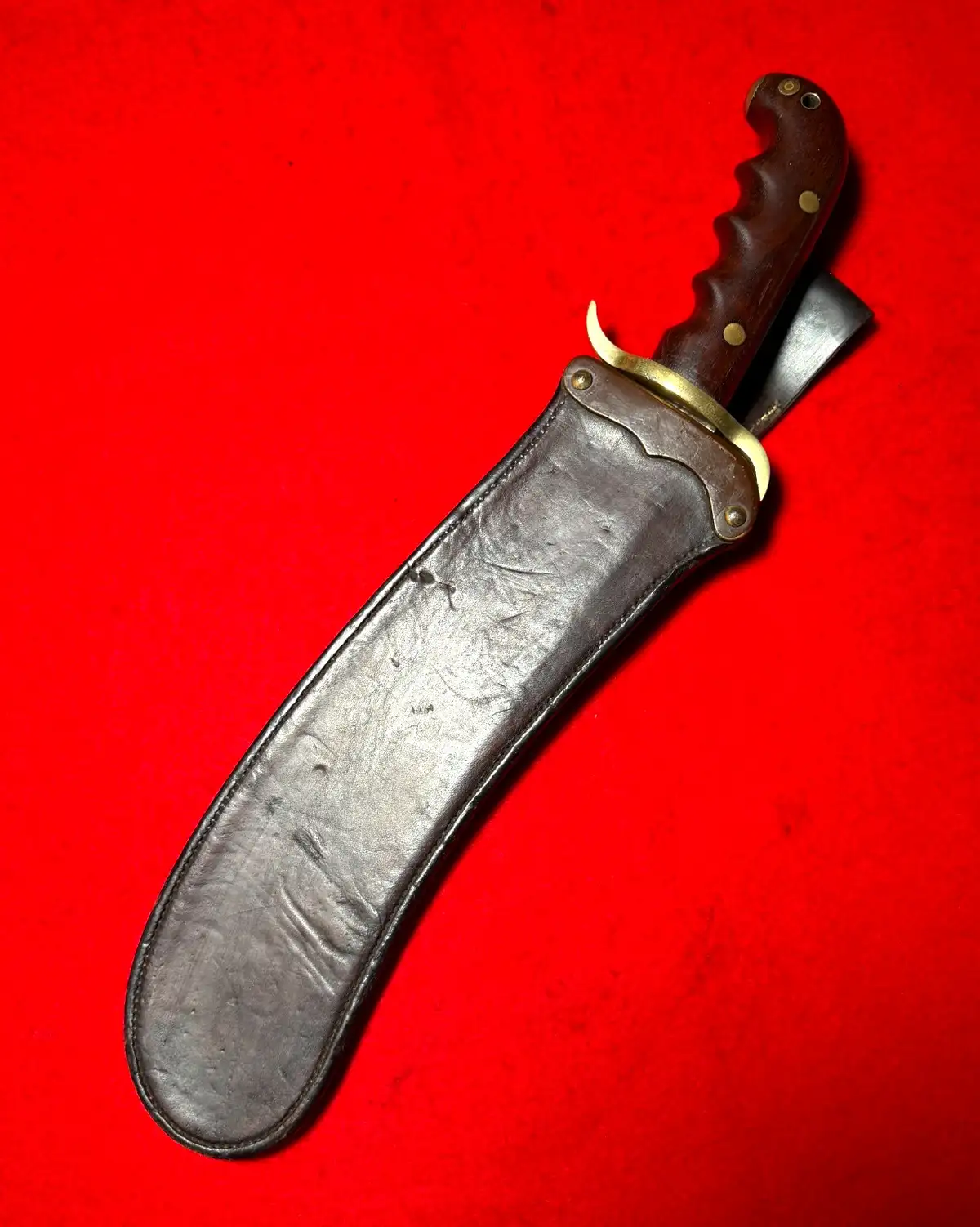
Leather body with a large metal throat, usually brass; several throat variations are known. Earlier scabbards have a plain leather belt loop stitched to the body. Later ones carry a metal belt hanger of the Krag bayonet type on a swivel, which is the arrangement found on most surviving examples.
Rock Island Arsenal made scabbards for the pattern. The mark sits on the reverse toward the tip, stamped in three or four lines: ROCK ISLAND, ARSENAL, the year, and an inspector's initials — ROCK ISLAND ARSENAL 1912 T.C.C. on one recorded example, and Rock Island / Arsenal / [year] / H.E.K. on another. Unit marks turn up in the leather as well, stamped by the issuing organisation rather than the arsenal; one example carries 1ST F.H. N.J. for a New Jersey field hospital.
Scabbard dates and blade dates are not expected to match. Blades and scabbards were issued and reissued separately for a decade and more.
Telling it from the patterns next to it
Against the M1909 bolo. All three Springfield bolos — M1904, M1909 and M1910 — carry the same S A / bomb / date and U.S. / serial layout, so the marking style identifies the armory and not the pattern. Size separates the M1904 from the M1909 first: the M1909 blade is quoted at 13.5 to 13.94 inches against the M1904's 12, and overall length at 19 to 19.5 inches against 17 to 17.25. The blade back separates them next: straight on the M1909, curved on the M1904. At the hilt, check the guard material — the M1909 guard is steel, the M1904 guard brass. The brass pommel cap proves nothing, because both patterns have one. Springfield built 17,540 M1909s between 1909 and 1915, well under half the M1904 figure. Dealers sometimes list the M1909 itself as a Hospital Corps bolo, which adds a second layer to the confusion.
Against the M1910 bolo. Shorter again — the blade is 10.25 to 10.5 inches, overall about 15 inches. The scabbard is the tell you can read across a room: a wood body covered in sewn pigskin under an olive drab canvas cover with a leather tip, a metal throat, a belt hook, and a second hook that engages the catch on the knife. No M1904 scabbard is canvas. Just under 60,000 M1910s were made between 1910 and 1917, making it the most numerous of the three.
Against the M1917 bolo. This is a simplified contract version of the M1910, with the scabbard catch mechanism deleted, a 10 3/8-inch blade and two rough-hewn wooden grip panels held by two screws. It carries a commercial maker name rather than S A and a Springfield date: U.S. / MOD 1917 opposite PLUMB / PHILA, PLUMB / ST LOUIS, or A.C.CO. CHICAGO for American Cutlery. Most are dated 1918, and that year on the blade is a date of manufacture, not a model number.
Against the M1887. The M1887 blade is also about 12 inches, so length will not separate the two. Thickness will: about 1/8 inch at the spine against the M1904's 3/8, on a blade 1.5 to 1.875 inches wide. It carries an etched panel and no serial number. An etched panel rules out the M1904.
Against a Philippine bolo
Bolo is a Filipino word for a working chopping knife, and it covers dozens of regional forms. The label was applied to US Army patterns from outside, and it describes a shape rather than an origin.
The lineage is worth stating plainly, because it is usually told backwards. The Hospital Corps knife line begins in 1887, a decade before American troops reached the Philippines. The M1904's ancestor is the M1887, not a captured bolo. Philippine and Cuban service did shape Army thinking about heavy brush knives, and the general-issue bolos of 1909 and 1910 are described in those terms — but the medical knife arrived by its own route.
An actual Philippine bolo carries no ordnance marks: no serial, no flaming bomb, no arsenal stamp. Hilts are carabao horn or hardwood, most without a metal guard. Blade profiles vary from province to province and from smith to smith, and forge marks and hammer texture are usually visible in the steel. Scabbards are two wood slabs bound with rattan or metal bands, not leather with an arsenal date on the reverse. A US pattern is one specification repeated forty thousand times. A village bolo is one smith's work, and it looks it.
What to look for
- Reverse ricasso stamped in three stacked lines: S A, a flaming ordnance bomb, and a year between 1904 and 1914.
- Obverse ricasso stamped U.S. above a serial number; numbering starts at 237, since the first 236 knives were delivered unnumbered, and the lowest serial recorded on a surviving knife is 264.
- A brass crossguard in a shallow S-curve, about 4.25 inches across the ends — a steel guard means the M1909, whose brass pommel cap is the same as this pattern's and settles nothing on its own.
- A 12-inch blade with a heavy curved back, about 3/8 inch thick at the spine, single-bevelled, ending in a rounded tip with no point; a straight-backed blade near 14 inches is the M1909.
- Two walnut grip scales with four finger grooves, secured by three large brass rivets, under a brass pommel cap drilled for a lanyard.
- A leather scabbard with a metal throat, marked on the reverse near the tip ROCK ISLAND / ARSENAL / year / inspector's initials — never a canvas-covered scabbard, which belongs to the M1910 or the M1917.