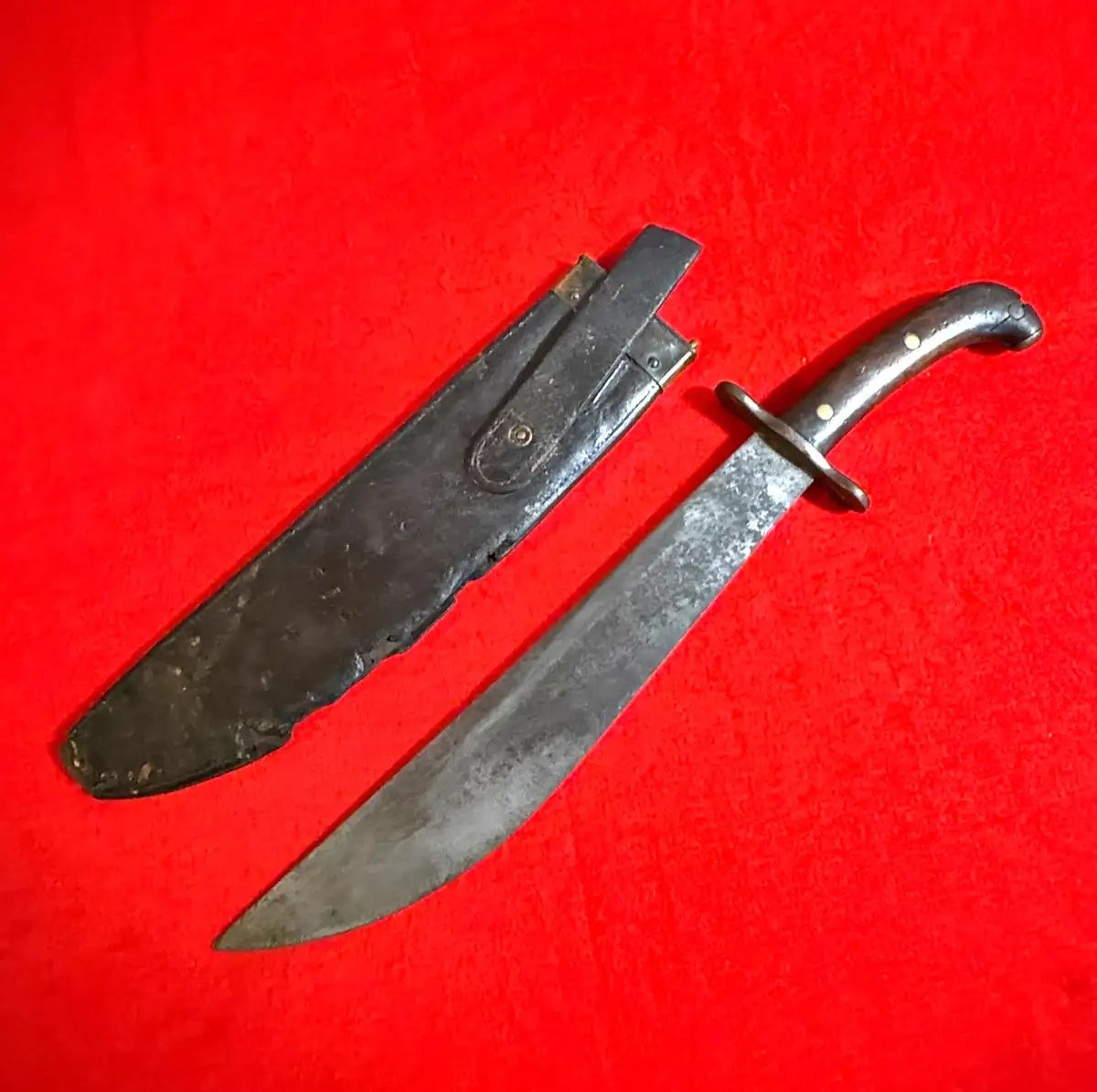
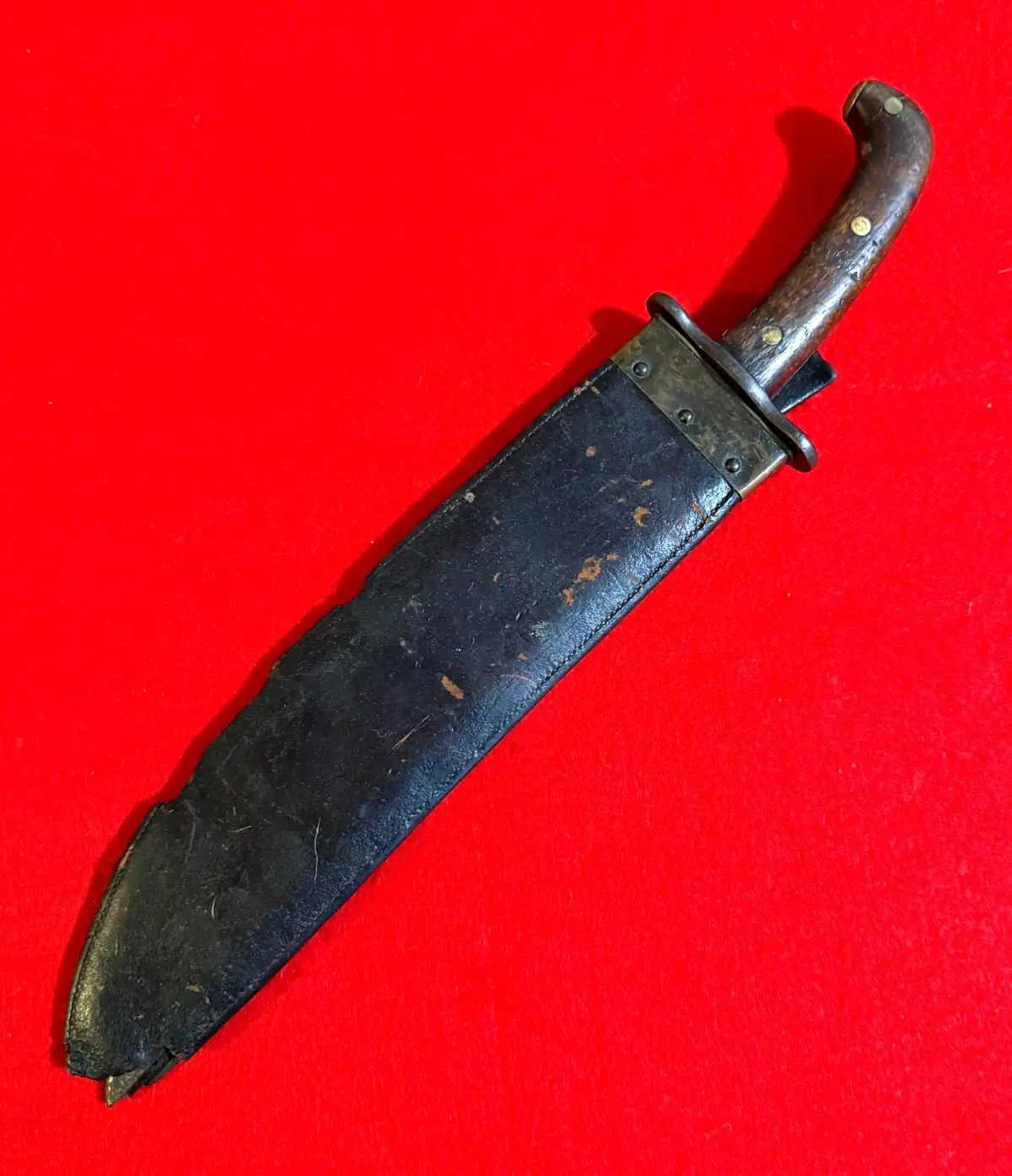
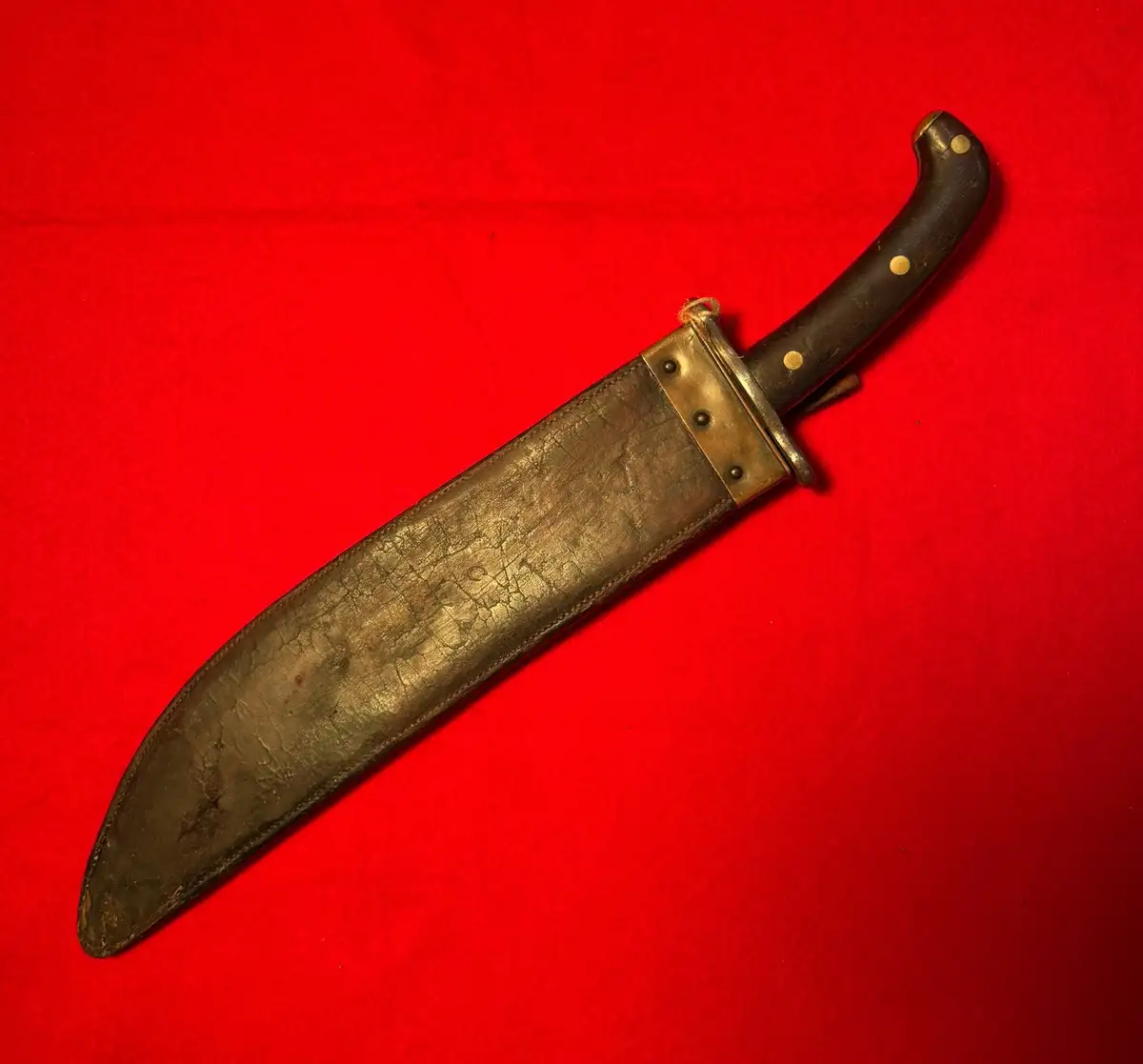
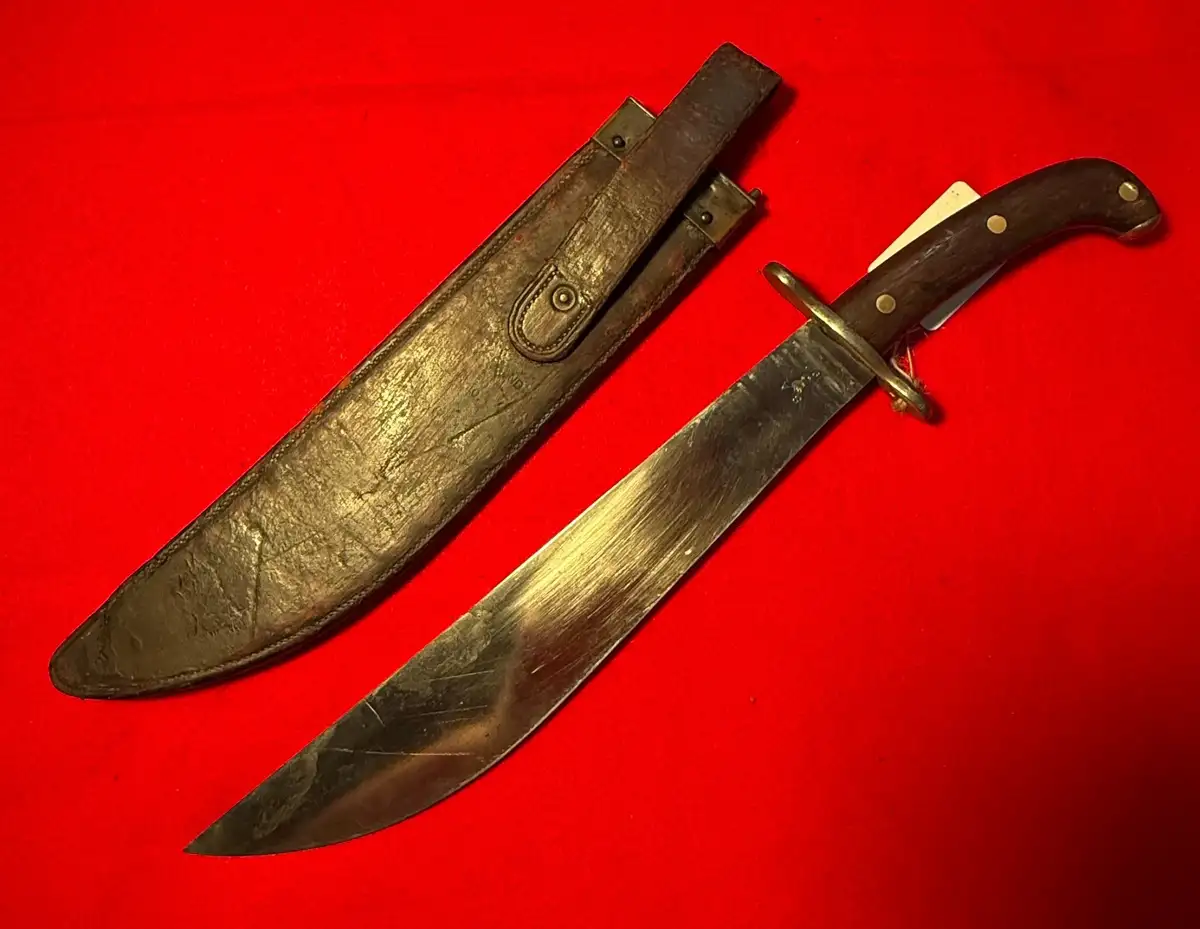
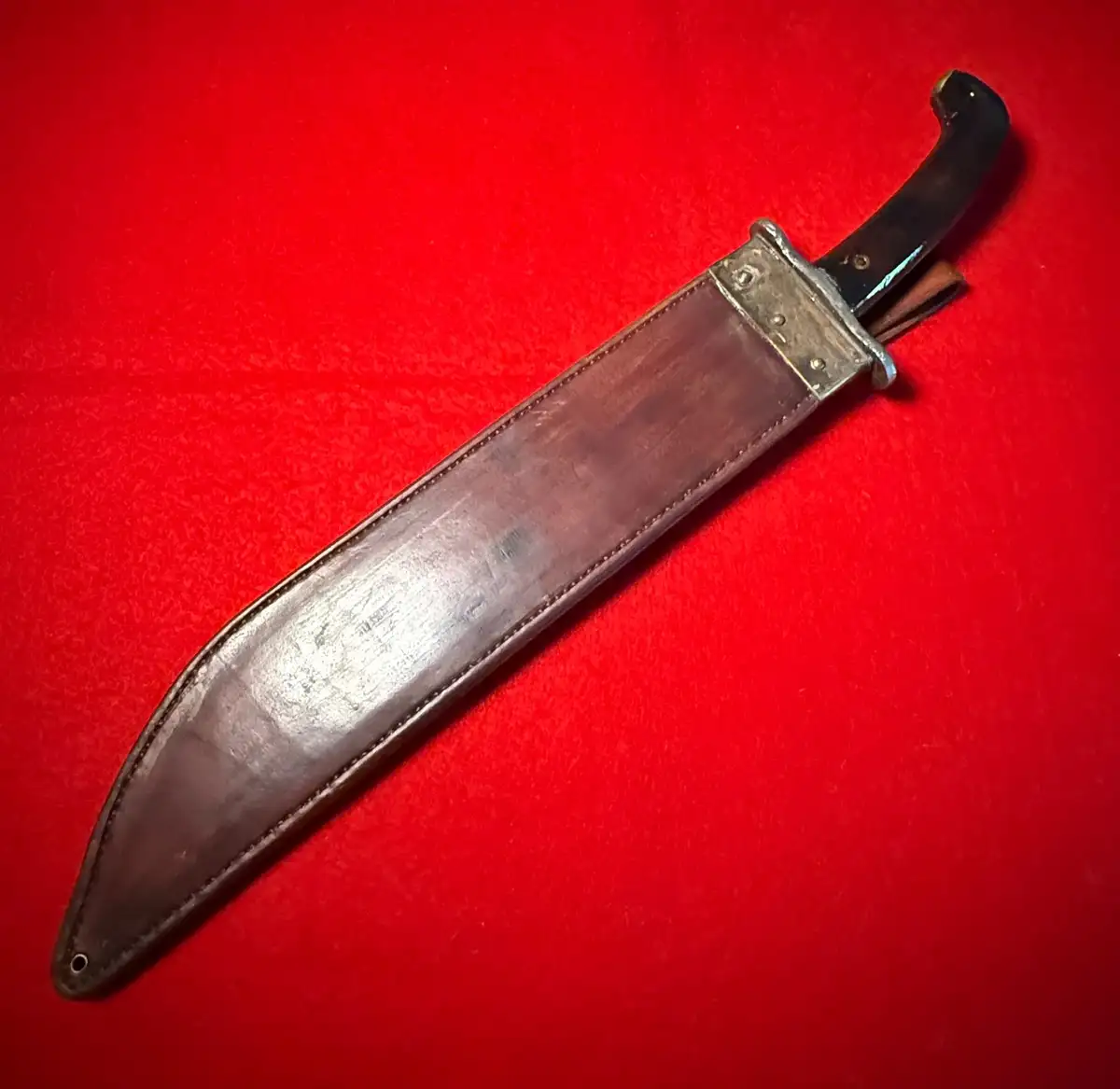
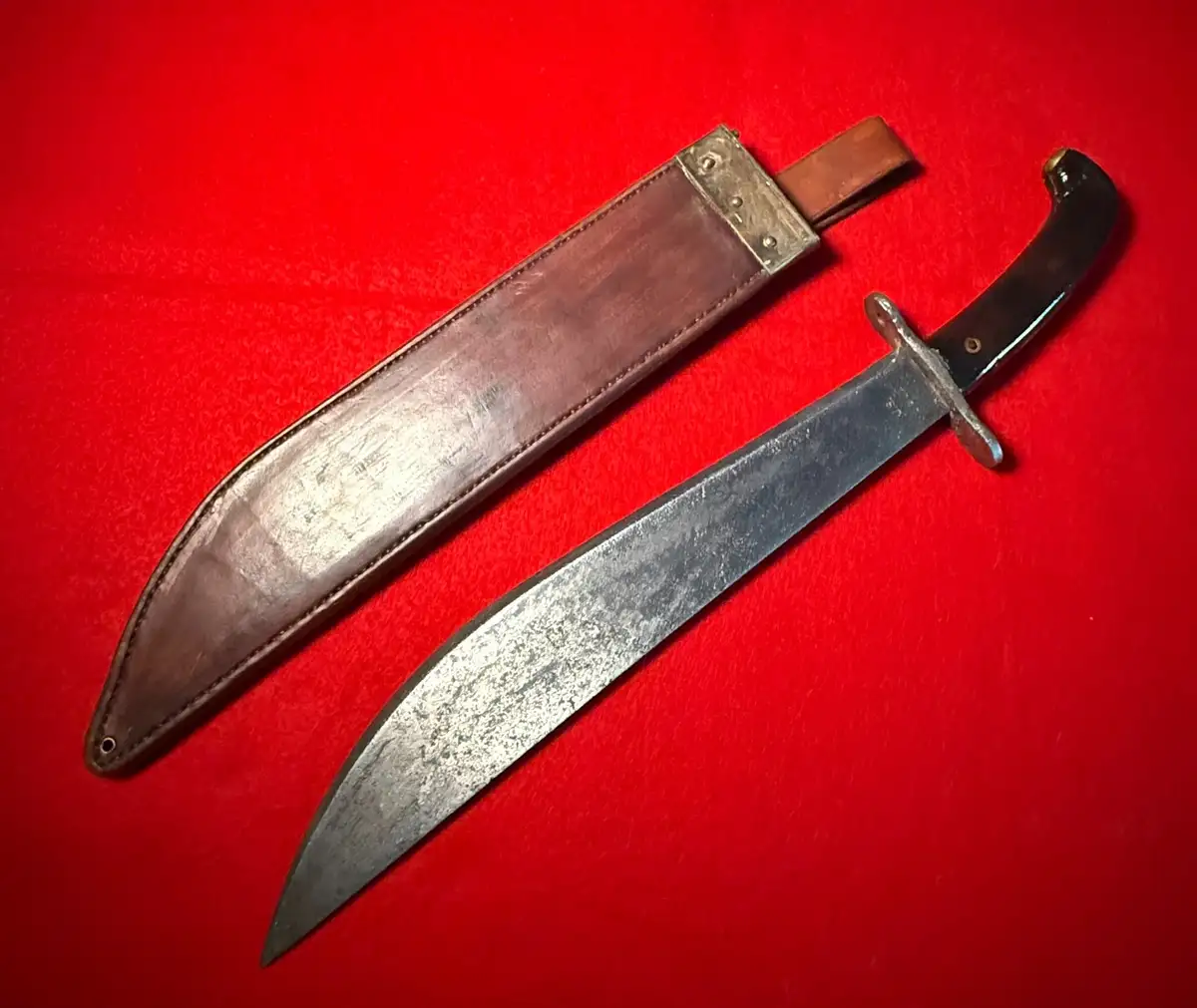
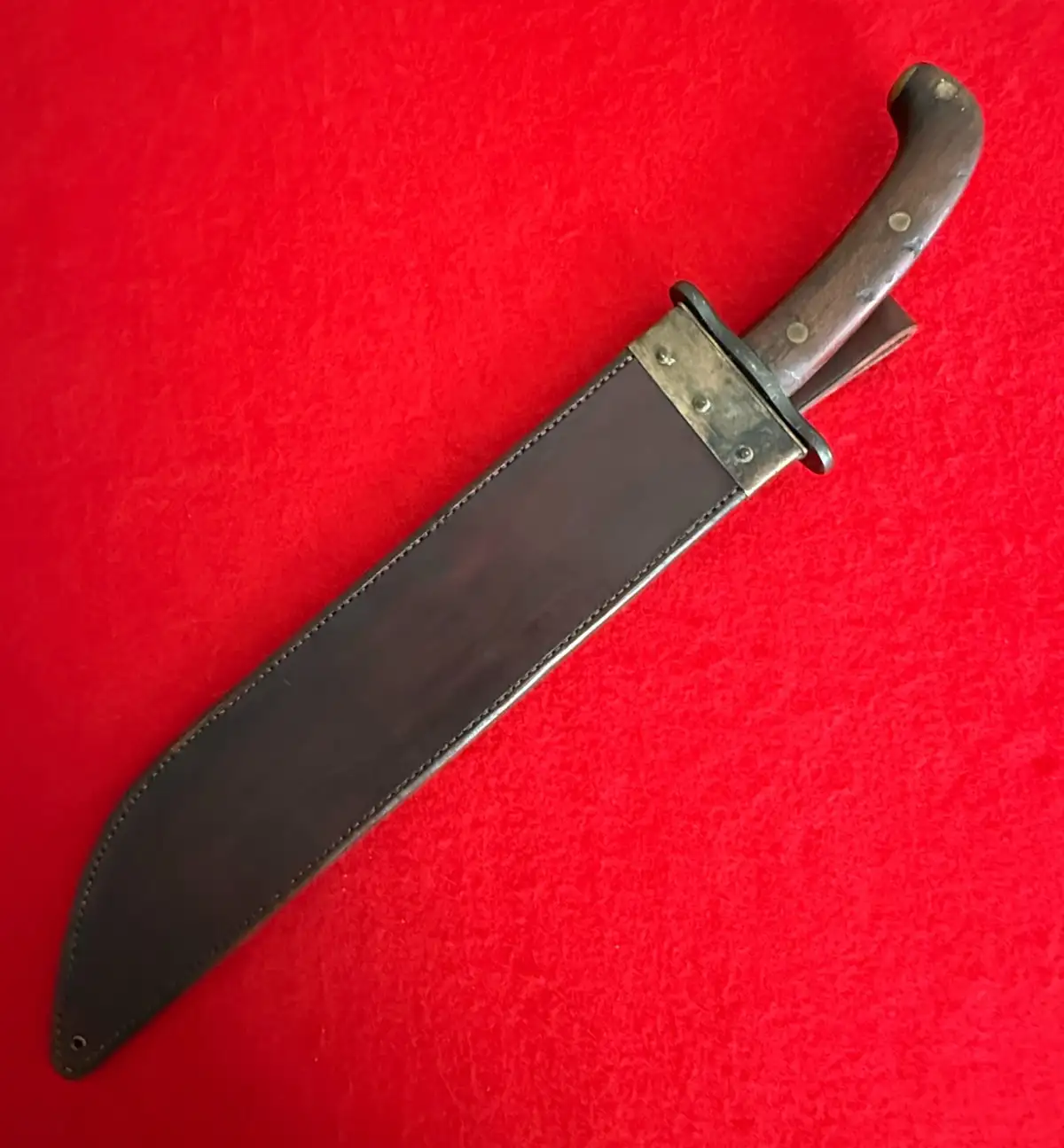
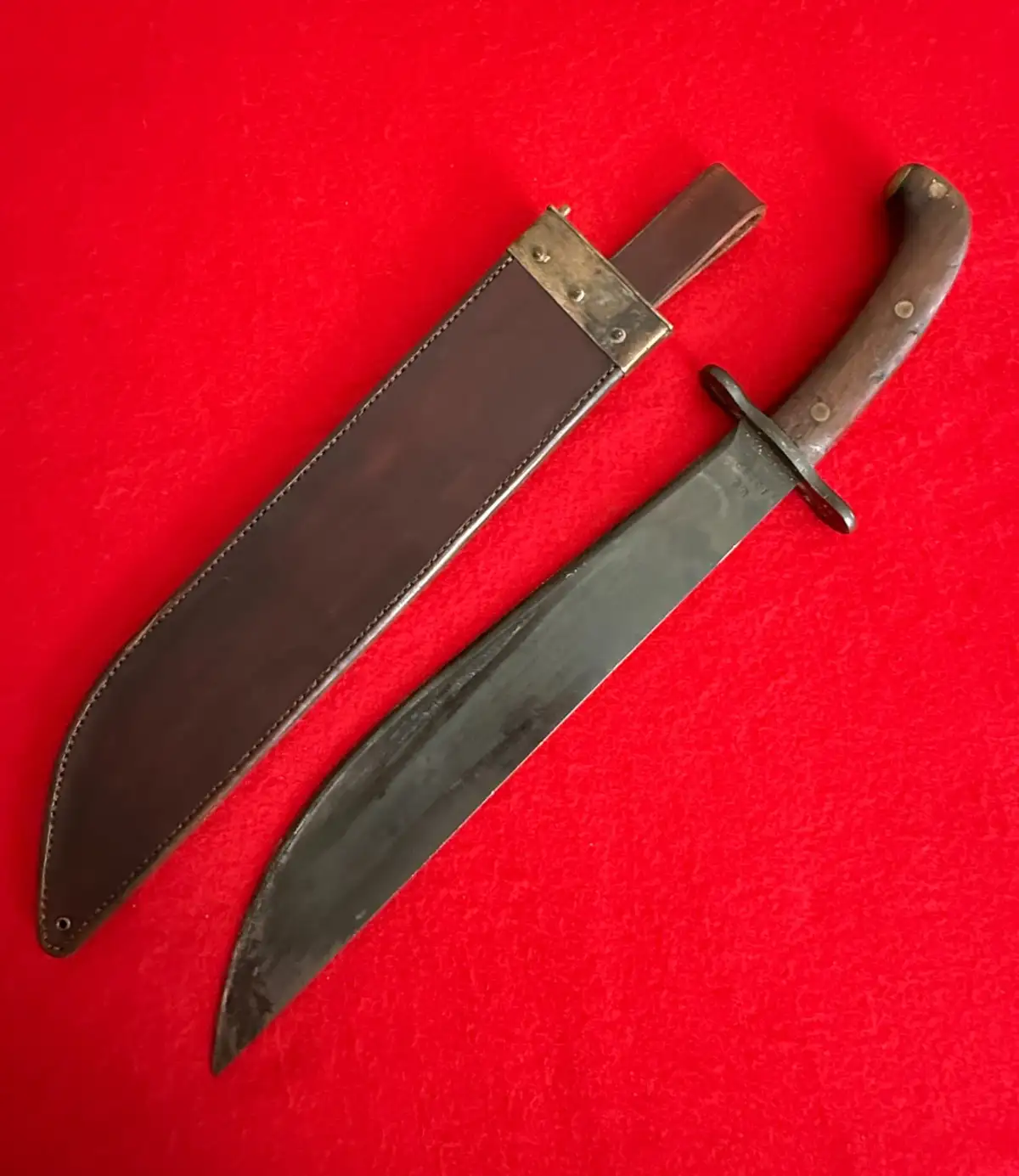
US M1909 Bolo Knife
Known in the trade as M1909 Bolo.
Springfield Armory's 14-inch belt bolo, made 1909 to 1915 in a run of 17,540, and a pattern number the market attaches to four different objects.
The pattern in one line
Springfield Armory made the M1909 bolo from 1909 to 1915 and finished 17,540 of them. Published blade lengths run from 13½ to 13.94 inches, with a width of about 2.3 inches at the belly and a thickness of 5/16 inch at the ricasso. Overall length is quoted between 19 and 19.52 inches. The sources do not state where they measured from, so the figures are approximate. What is not approximate is the gap to the next pattern along: the M1910 and M1917 blades are 10¼ inches.
The profile is a straight back running the full length of the blade, a cutting edge that curves away from it, and the width carried forward into a belly near the point. The mass sits ahead of the hand.
The edge is ground from one side. IMA describes Springfield examples as single-bevelled; Rock Island Auction describes the related bolo bayonet blade as chisel-ground. Dealer accounts tie the form to the bolo the Army encountered in the Philippines and in Cuba.
Springfield marks, and the Plumb blades of 1917
Both flats at the base of the blade are stamped. One ricasso carries S A over a flaming bomb over the year of manufacture. The other carries U.S. over a serial number.
The blade finish is bright polished steel. A grey phosphate surface on a large bolo points to the 1917 contract production rather than to Springfield. Guards are a separate question: blued steel guards are recorded on Springfield M1909s, so a dark guard under a bright blade is not by itself wrong.
In 1917 Fayette R. Plumb of Philadelphia produced the large pattern under wartime contract. Those blades read PLUMB over PHILA over a flaming bomb over 1917, with U.S. and a serial on the reverse. The IMA example measures 13 7/8 inches in the blade and 19¼ inches overall, within the Springfield range. Dealers catalogue them as M1909s; Springfield Edge records the Ordnance Department redesignating the Plumb and Collins production as M1917. The stamp is the part that can be checked on the object.
Serial numbers are no guide to quantity. A 1912 Springfield has been observed at 14056 and a 1917 Plumb at 55790 — the latter well above Springfield's whole run of 17,540. No published serial-to-year table exists for this pattern.
The scabbard
Scabbards for the M1909 came from Rock Island Arsenal, in leather, with a metal throat. The throat carries a pin roughly 7/16 inch long, and that pin enters a hole through the crossguard, so the knife is retained by its own guard rather than by a strap over the grip. This is not a test that identifies the pattern — the M1910 and M1917 crossguards are drilled too, and Windlass copies the pin in its reproduction scabbard.
The stamp sits on the reverse of the scabbard, low down, in four lines: ROCK ISLAND over ARSENAL over the year over the inspector's initials. Recorded examples include 1909 T.O.O., 1911 H.E.K. — that one with L.S. and W.P. sub-inspector stamps — and 1918 P.F.G.
Springfield Edge records three Rock Island variants but does not describe them. A scabbard dated later than the blade is ordinary, since scabbards wore out and were replaced from stores, so a mismatch of years between knife and leather is not by itself a problem.
What it followed: the M1904 Hospital Corps knife
The M1904 is the knife the M1909 came after, and the two are not interchangeable. The M1904 blade is 12 inches long, 2¼ inches wide, 3/8 inch thick, about 17¼ inches overall. Springfield made more than 40,000 between 1904 and 1914. The first 236 left the armory unnumbered; serials begin at 237 after the Surgeon General required them, and the lowest number so far documented is 264. No 1906-dated example has been recorded.
The hilts settle it. The M1904 has a curved brass handguard, two-piece walnut scales cut with finger grooves, three large brass rivets, and a Mameluke-style curved brass pommel cap pierced for a lanyard. The M1909 has a plain steel crossguard on Springfield production, wood scales without the M1904's finger grooves, and a brass cap at the butt.
The blades settle it twice over. The M1904 point is rounded and the widest part of the blade sits well back from it; the M1909 carries its width forward and its stock is thinner, 5/16 against 3/8.
The M1904 was the Hospital Corps knife, issued to medical personnel for clearing brush, cutting splints and making stretcher poles — not, despite the auction copy, for surgery. Sources support only that the M1909 was designed to be carried as a belt knife. Dealers list it under both names, so an M1909 will be found catalogued as a Hospital Corps bolo as well.
Telling it from its neighbours
M1910 bolo. The one most often mixed up with the M1909, and length separates them at arm's length: 10¼-inch blade, 15 inches overall, 2⅛ inches wide, ¼ inch thick. Just under 60,000 came out of Springfield between 1910 and 1917, and records place them with machine gun companies for clearing fields of fire. The pommel is a steel bird's head, the two-piece walnut grips are held by screw bolts with recessed slotted nuts, and the hilt was blued. The M1910 crossguard is also drilled: a stud on the scabbard's metal throat passes through the hole and is secured by a press-stud catch on the back of the tang. The standard scabbard is wood covered in sewn pigskin with a metal throat, a metal belt hanger and a canvas cover with a leather tip. A canvas or webbing scabbard is not an M1909 scabbard.
M1917 bolo. Dimensionally the M1910 — same 10¼-inch blade, same 15 inches overall — made by Fayette R. Plumb at Philadelphia and at St. Louis and by American Cutlery of Chicago, dark-finished rather than bright. The change from the M1910 was the deletion of the spring catch; the crossguard hole was kept so that stocks of M1910 scabbards would still take the knife. It states its own model number on the blade: U.S. over MOD. 1917 over C.T. on one side, maker and year on the other, as PLUMB ST. LOUIS 1918 or A.C. CO. CHICAGO 1918. No M1909 carries a model number on the blade.
The 1918 bolo. No bolo was adopted as an M1918. A 1918 date on a bolo blade sits beside a maker's name, and the model line on those same blades reads MOD. 1917. The M1917 and M1918 trench knives and the M1918 Mark I — cast brass knuckle grip, double-edged blade — are separate objects with no bolo blade.
The 1909 bolo bayonet. A separate object with the same number: 50 made at Springfield in fiscal 1911 and 52 in fiscal 1913, 102 in all, on a blade of about 14 inches. The hilt is contoured to mate with an M1905-type pommel, the tang carries an M1905-style push-pin catch on the left side, and a muzzle ring is worked into the crossguard for the M1903 rifle. Fakes are built by welding an M1892 bayonet hilt onto an M1909 bolo blade; the join and the pommel metal are where that shows.
Commercial copies. Windlass Steelcrafts and the dealers who retail its work sell a reproduction listed at a 15-inch blade, 19 inches overall, ¼ inch thick and about 2 lb, in a leather scabbard with a pin in the metal throat and a copied Rock Island Arsenal stamp. It is longer in the blade and thinner in the stock than the original, and it carries no U.S.-over-serial pairing at the ricasso.
What to look for
- Measure the blade from the front face of the guard: an M1909 runs 13½ to 14 inches, about 2.3 inches wide at the belly, 5/16 inch thick at the ricasso. The M1910 and M1917 are 10¼ inches and ¼ inch thick, and length is the reliable separator between them.
- Do not use the hole in the crossguard as an identification: the M1910 and M1917 guards are drilled as well, and the Windlass reproduction scabbard copies the throat pin. Only the M1910 adds a press-stud catch on the back of the tang behind the guard.
- Read both ricassos: S A over a flaming bomb over the year on one side, U.S. over a serial number on the other, with no model designation on the blade. A blade reading U.S. over MOD. 1917 over C.T. is the 10¼-inch pattern, not this one.
- On the 1917 contract large bolos, expect PLUMB over PHILA over a flaming bomb over 1917 in place of the Springfield mark, with U.S. and a serial still opposite; observed serials run well above Springfield's total of 17,540.
- Turn the scabbard over and look low on the back for four lines reading ROCK ISLAND, ARSENAL, a year, and an inspector's initials; the year need not match the knife.
- Check the butt and guard together — brass cap and plain steel crossguard for the M1909, curved brass guard with finger-grooved scales, three brass rivets and a Mameluke cap for the M1904, steel bird's-head pommel for the M1910 and M1917.