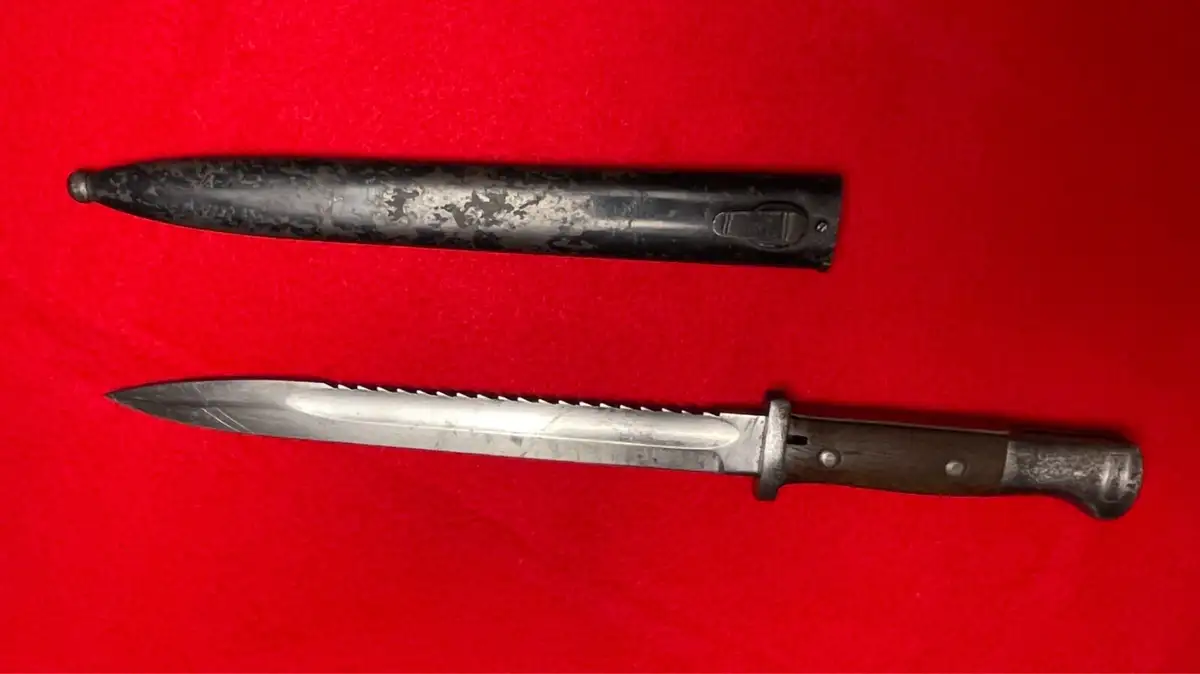
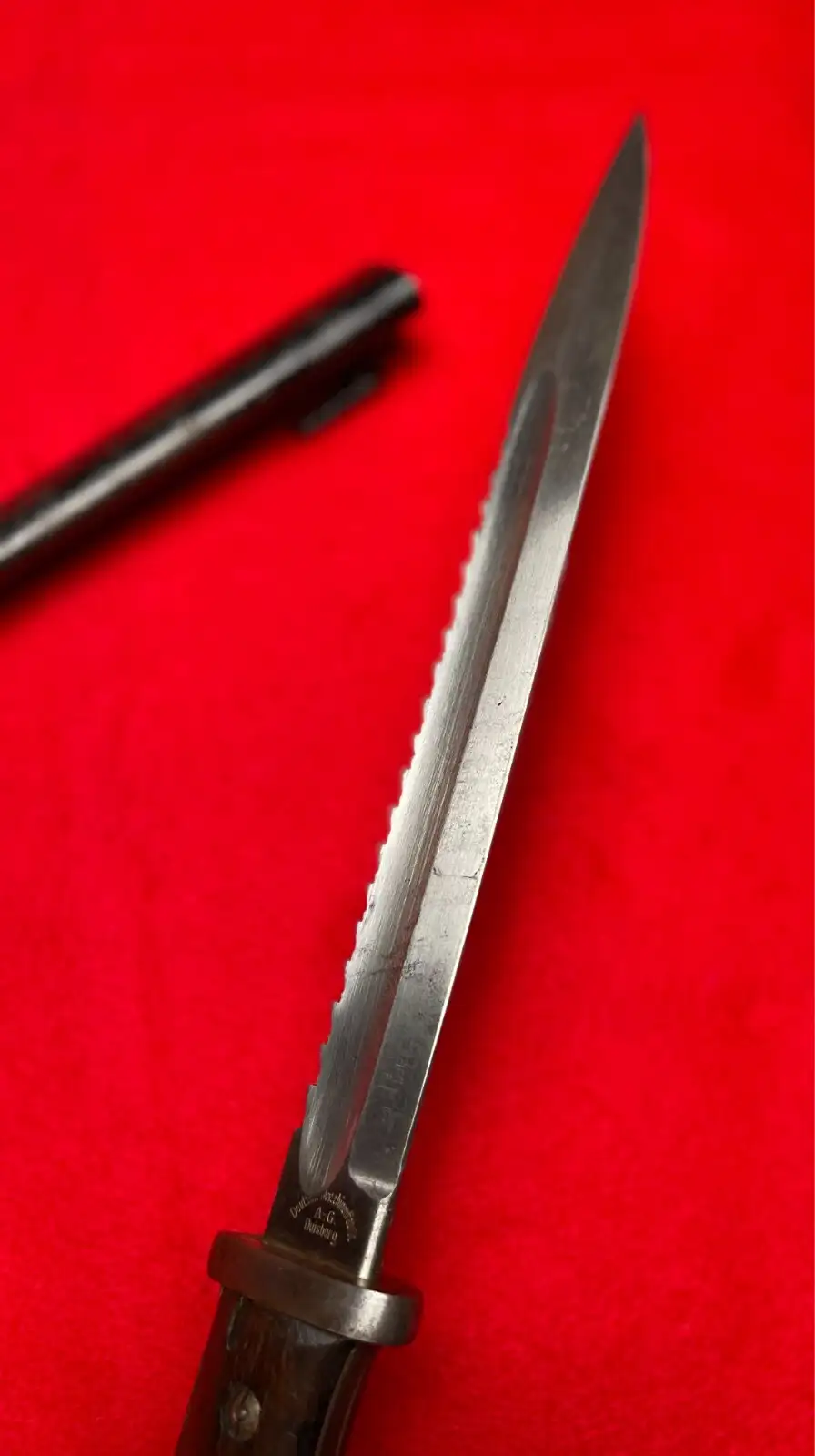
Mauser, Oberndorf am Neckar
Known in the trade as Mauser.
Mauser built rifles at Oberndorf and marked bayonets there in only one narrow window, which is why most objects sold as "Mauser bayonets" were made by other firms in other towns.
A monastery, then a rifle factory
On 31 July 1811 King Friedrich I of Württemberg ordered a state rifle factory installed in the Augustinian monastery at Oberndorf am Neckar, secularised five years earlier. Production began on 6 November 1812 with about a hundred employees. Württemberg belonged to Napoleon's Confederation of the Rhine and owed him troops, and the troops needed muskets.
Franz Andreas Mauser (1792–1861) worked in that factory as a gunsmith. So did his sons, Wilhelm, born 1834, and Paul, born 1838. From 1867 the brothers worked with Samuel Norris, an American agent for Remington, on a turn-bolt breech-loader; the partnership yielded a United States patent in June 1868 but no production contract, and it dissolved when France showed no interest in converting its Chassepots. Their next design was accepted by the Prussian government on 2 December 1871 as the infantry rifle M/71.
In 1874 the state sold the royal factory to the two brothers. Gebrüder Mauser & Cie. became the stock company Waffenfabrik Mauser on 1 April 1884. Wilhelm had died on 13 January 1882; Paul died in 1914.
Ownership then moved to Berlin. On 28 December 1887 the Berlin firm Ludwig Loewe & Co. bought a controlling share, with Paul staying on as technical head, and on 7 November 1896 Loewe's arms interests were consolidated into Deutsche Waffen- und Munitionsfabriken. Berlin capital, Oberndorf name.
The name on the listing belongs to the rifle
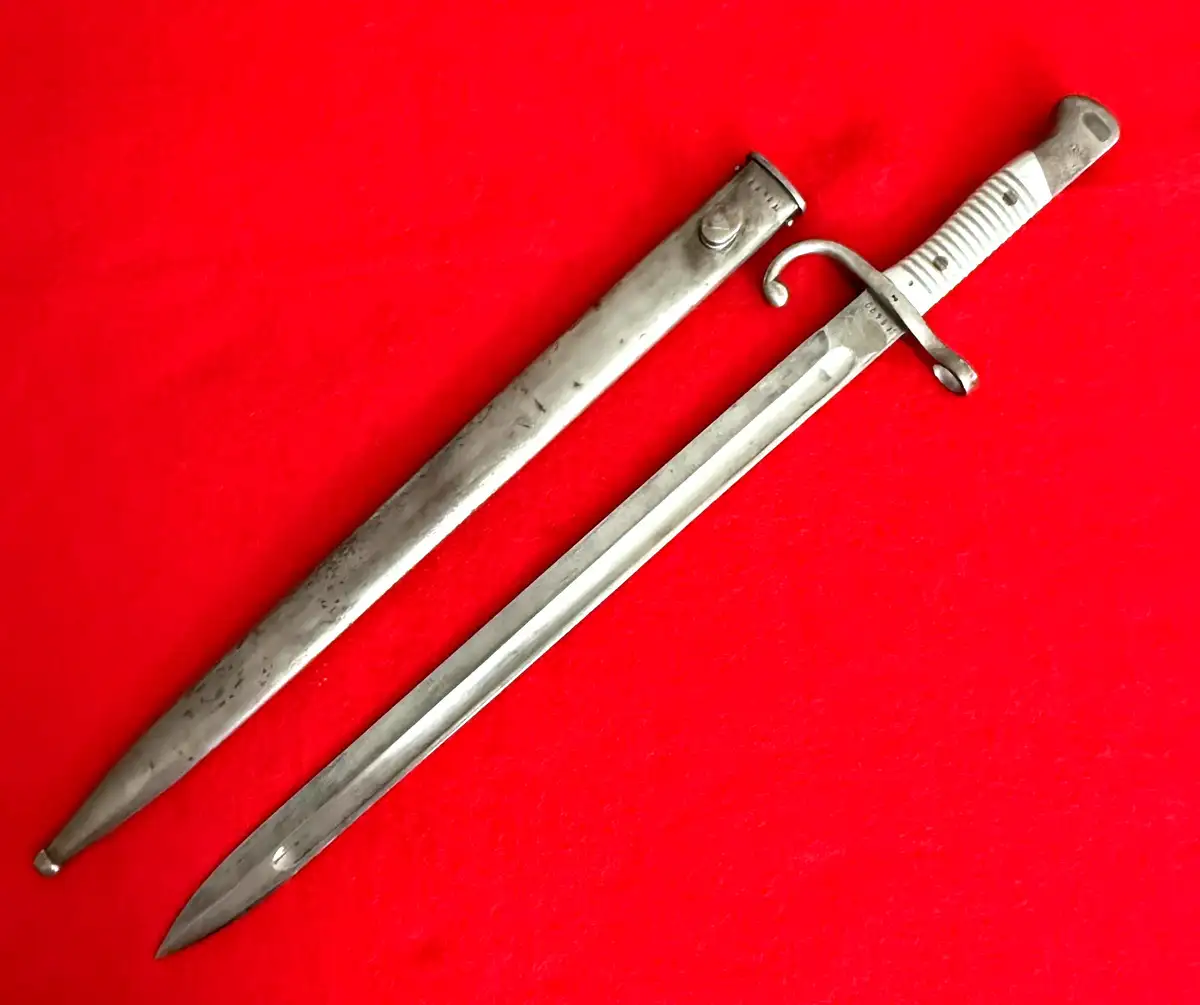
Take the Modelo Argentino 1891. Production ran at Ludwig Loewe in Berlin and, from 1896, at DWM — not at Oberndorf.
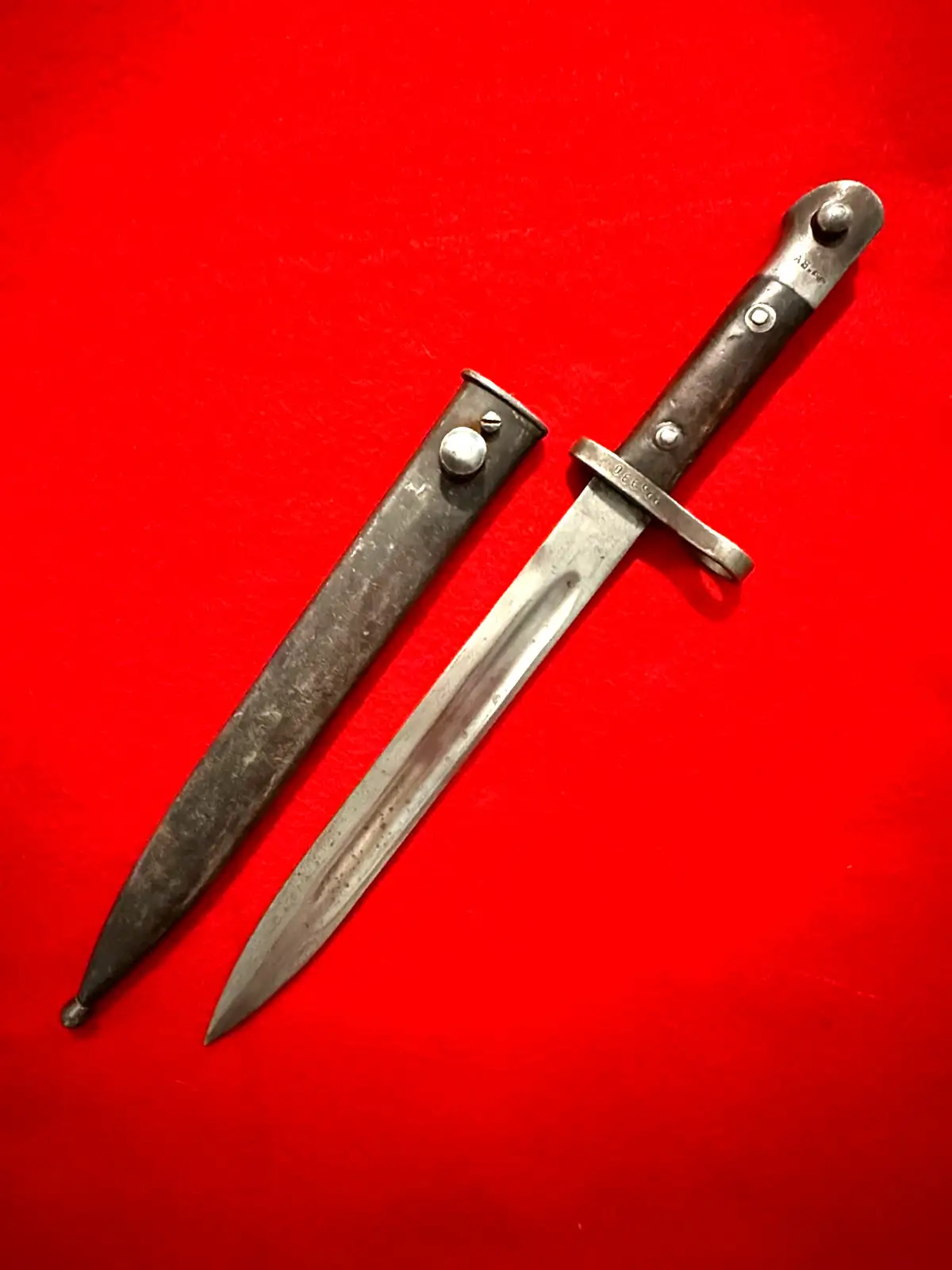
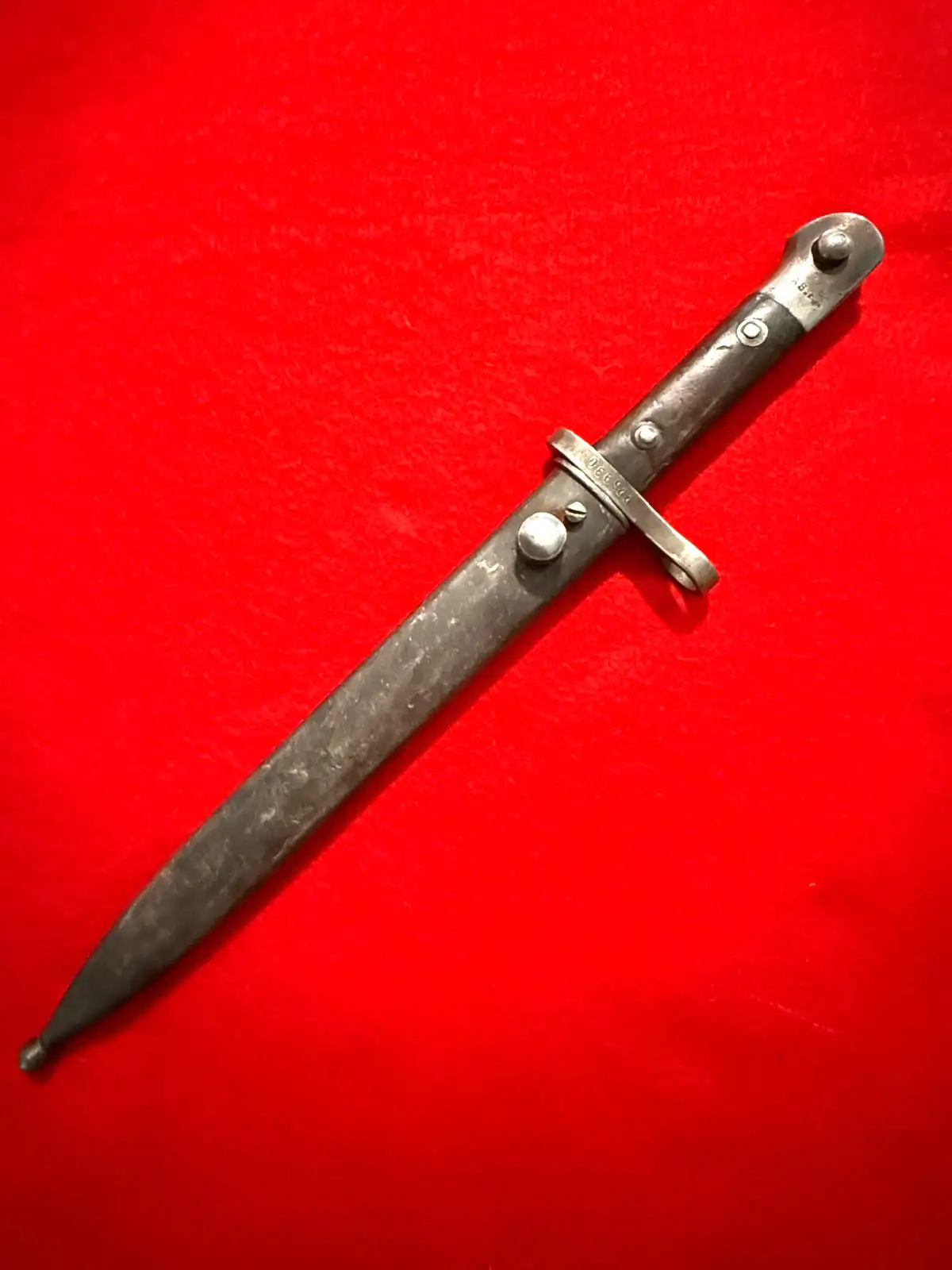
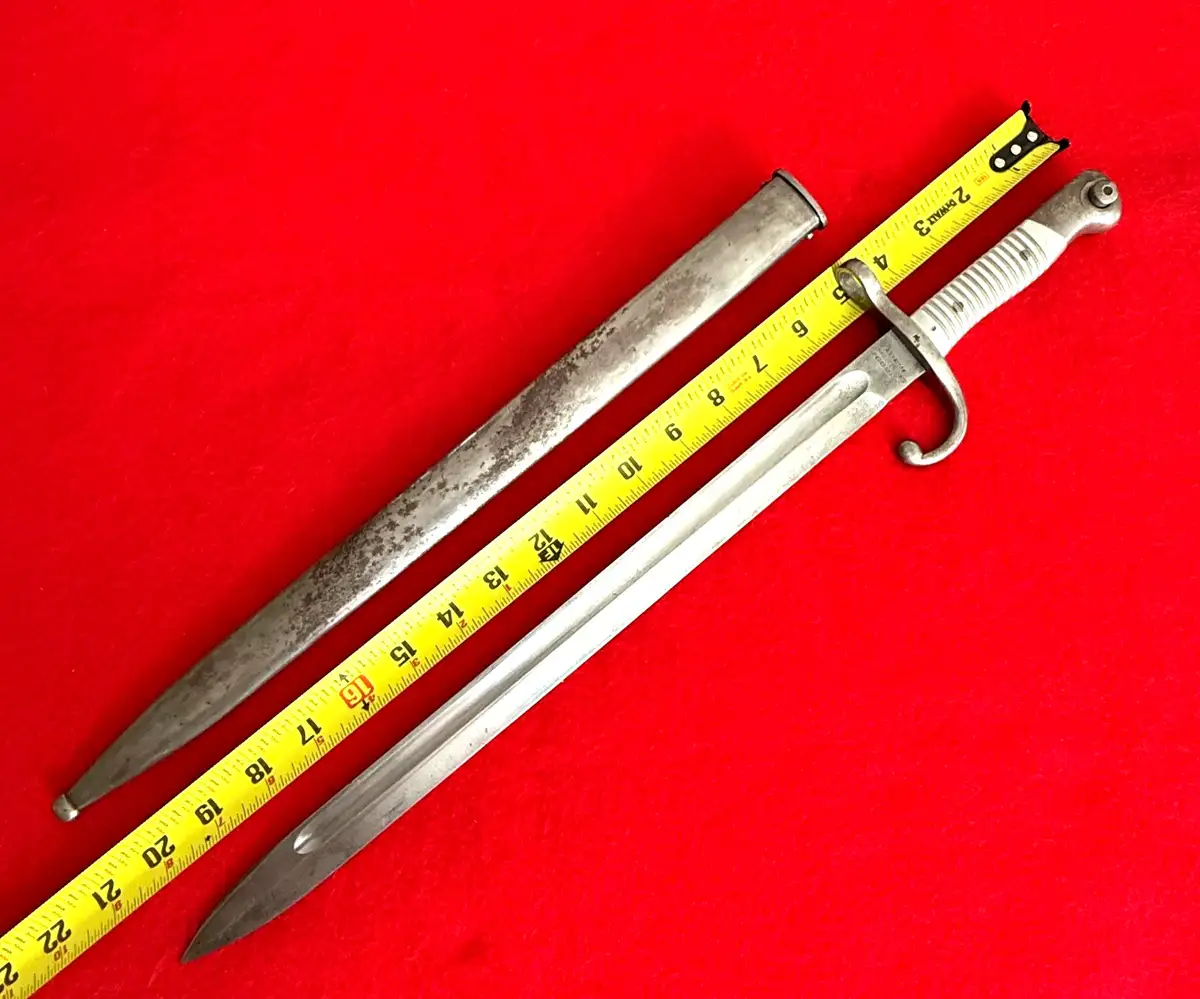
The bayonet for it was made somewhere else again. Its maker's face reads WEYERSBERG, KIRSCHBAUM & CO. SOLINGEN together with MODELO ARGENTINO 1891; the opposite face carries the Argentine crest, which was commonly ground off before surplus sale. The blade runs 399 mm, about 15.7 inches, with an overall length near 521 mm.
The Chilean Mo 1895 followed the same division of labour. Rifles from Loewe and DWM between 1895 and 1900; bayonets from Weyersberg, Kirschbaum in Solingen from 1895 to 1901, with the Chilean crest on one face, the Solingen address on the other, and the three interlocking rings of the Krupp trademark. The Chilean blade is a short one, around 250 mm, against the Argentine pattern's 399 mm.
Belgium went further still. Fabrique Nationale was founded at Herstal in 1889 by a consortium of Liège gunmakers, with Henri Pieper as its prime mover and principal shareholder, to fill an order for 150,000 Mauser Model 1889 rifles. The first were assembled at the end of 1891.
So three firms, and only one of them Mauser: the action designed at Oberndorf, the rifle built in Berlin or Herstal, the blade ground in Solingen. When a listing says "Mauser bayonet", it is describing the rifle the thing fits.
Where Oberndorf does appear on a blade
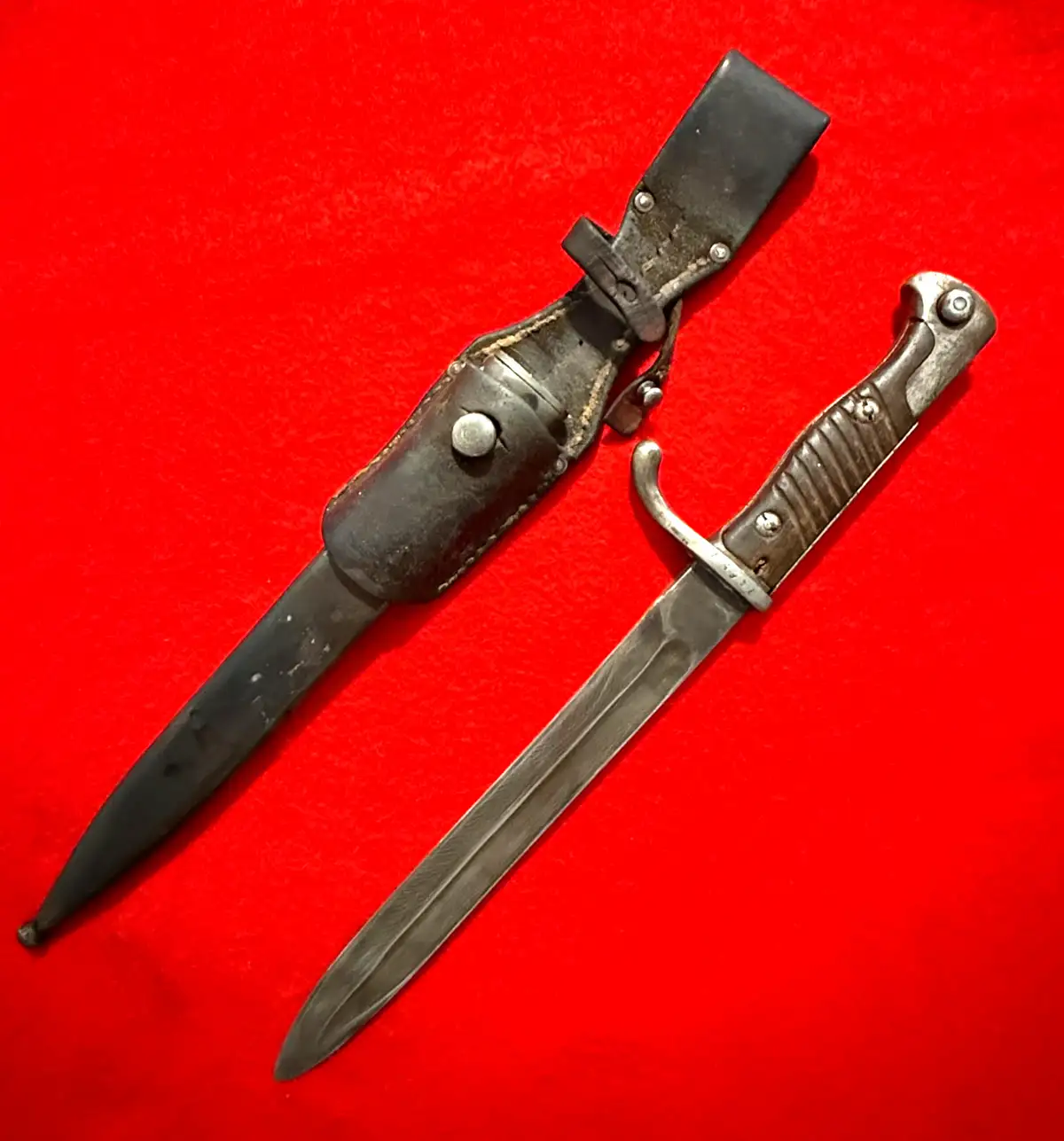
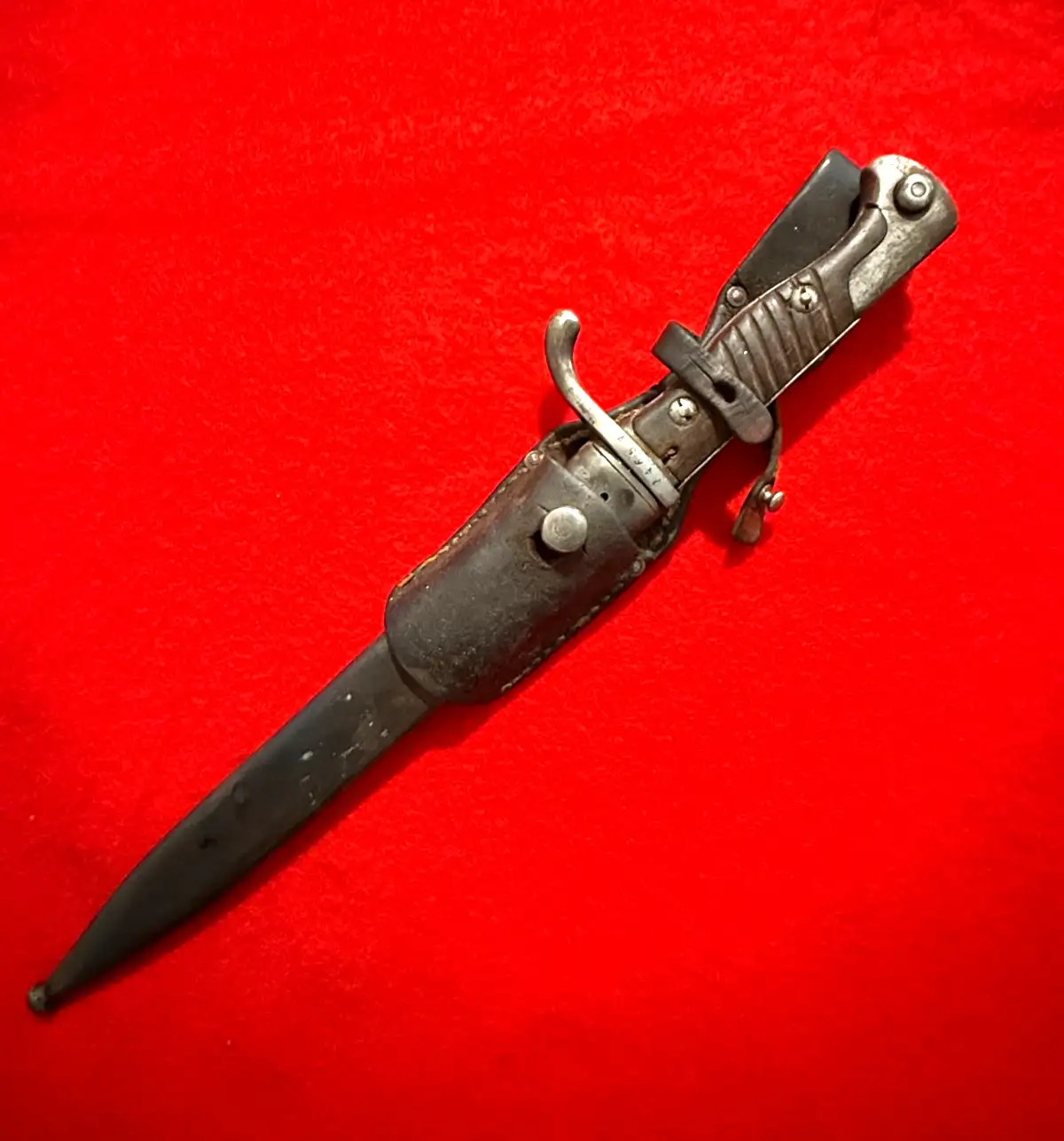
There is a real exception. Bayonets exist with WAFFENFABRIK MAUSER A.G. OBERNDORF a/N. stamped across the ricasso, and they are genuine.
They are of the S98/05 pattern — the broad, cleaver-profile blade collectors call the butcher — and the Mauser-marked examples are dated 1915 to 1918. Collectors distinguish at least three variants of the Oberndorf ricasso marking across those years, including one that sets a dash between Mauser and A.G.
The pattern itself is older and much wider than the Mauser mark. It was introduced in 1905, the Prussian arsenal at Erfurt was producing it by 1908, and Simson & Co. of Suhl made it during the war. Set a Mauser-marked 98/05 next to a Simson one and you are looking at two firms filling the same specification, which is what an army contract is.
So the pattern spans a decade and many contractors, while the Oberndorf mark on it sits inside the war years. Outside that window, Oberndorf's name on a blade is a claim to check rather than a fact to accept.
1935 to 1945: Solingen names, not Mauser
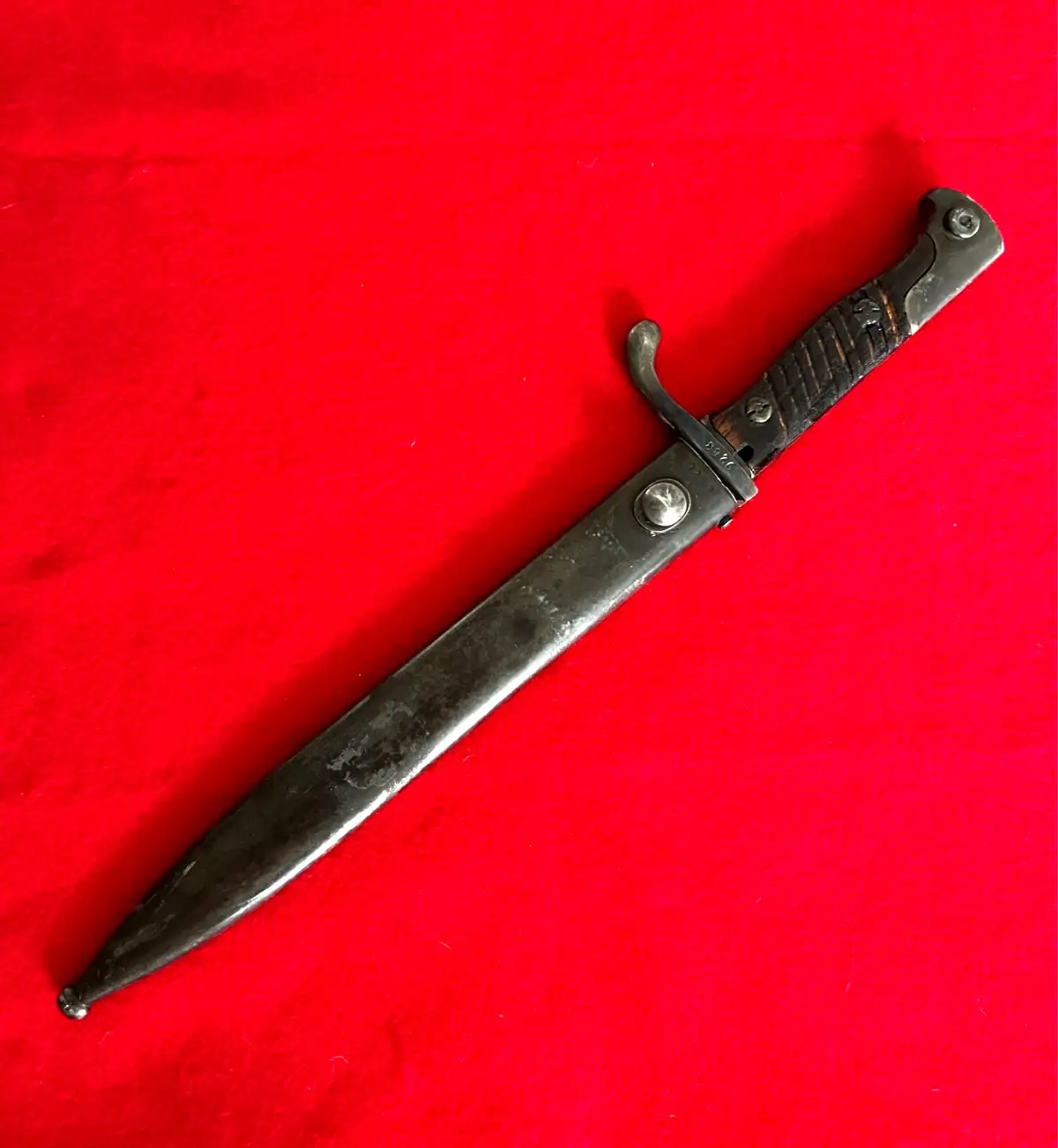
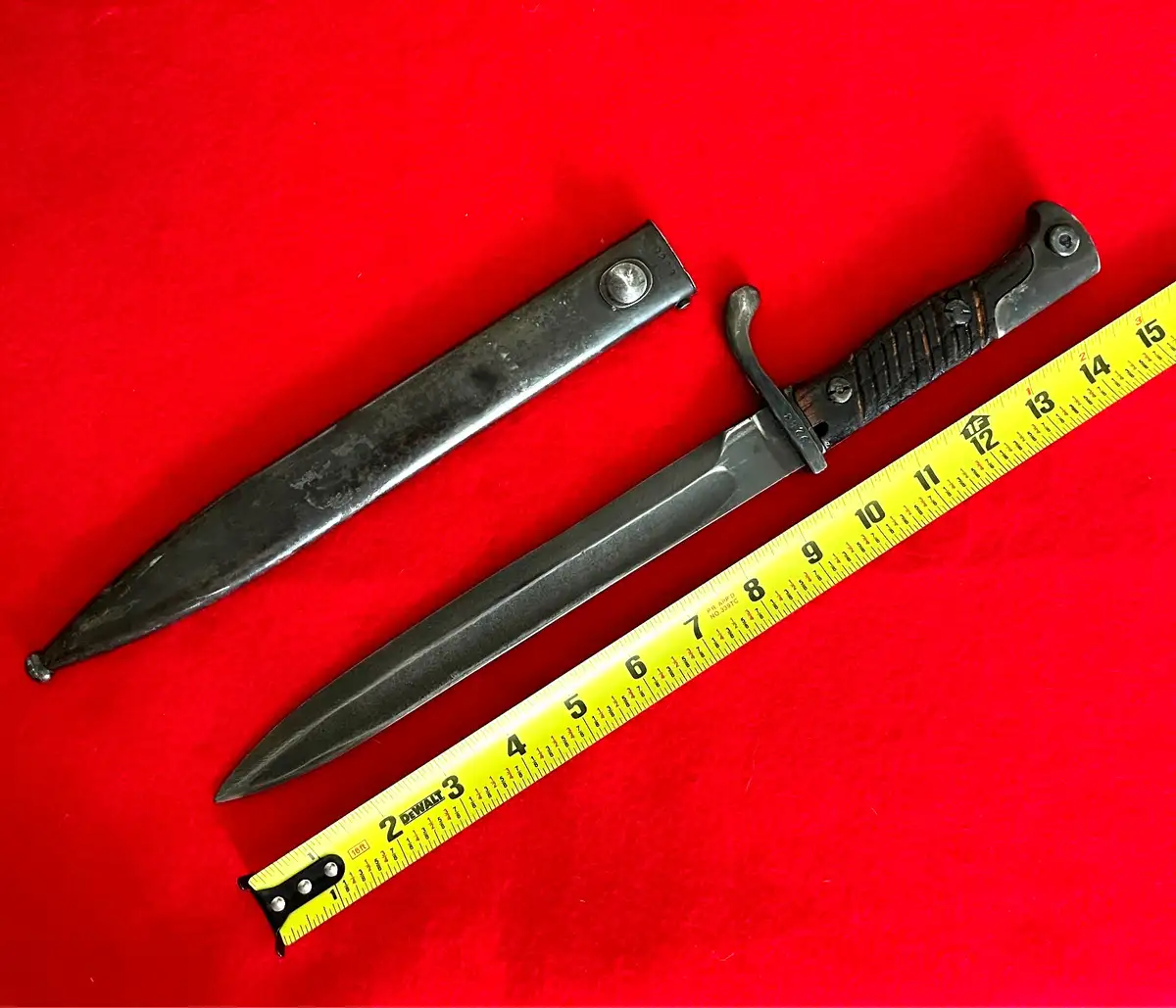
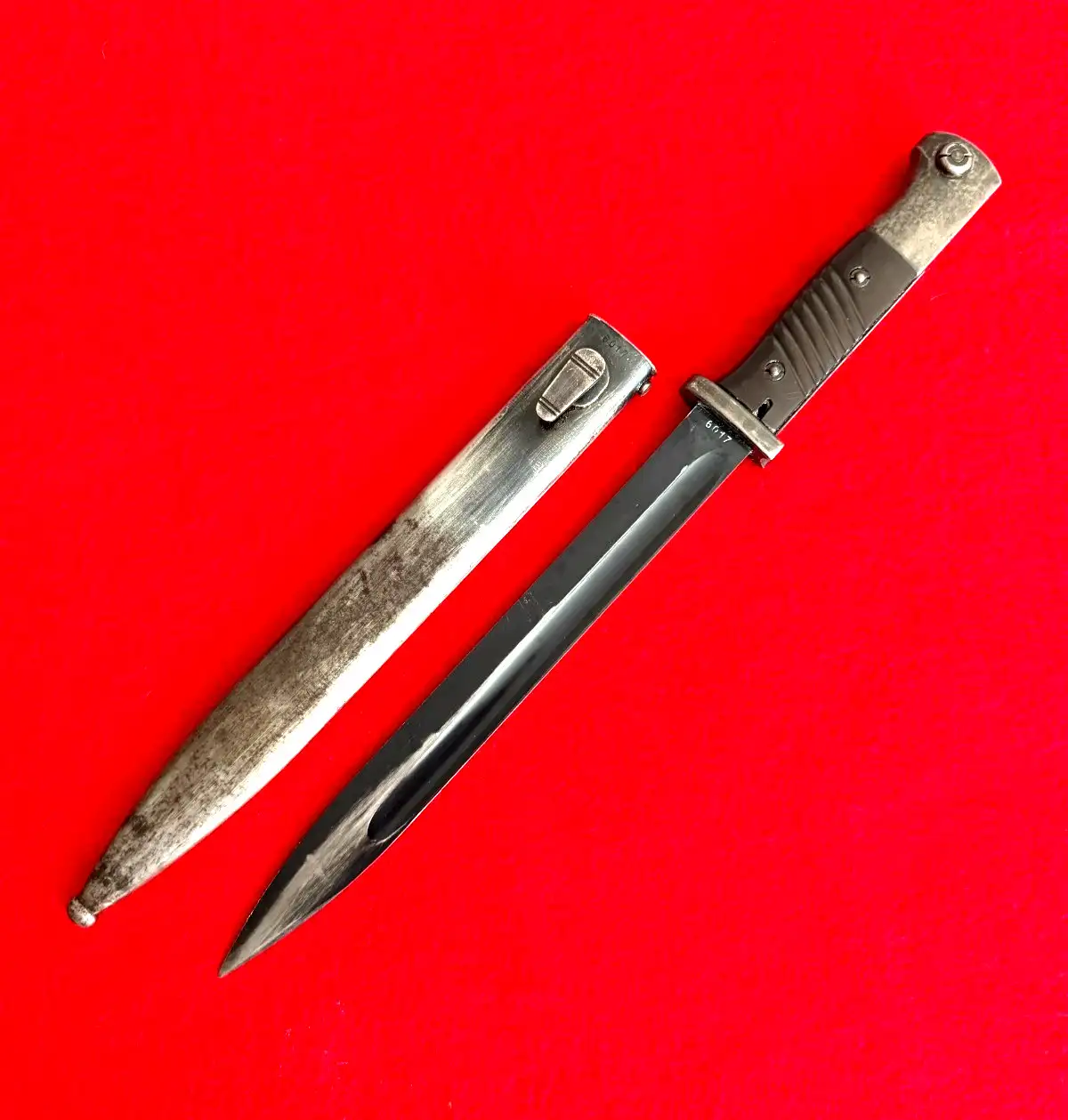
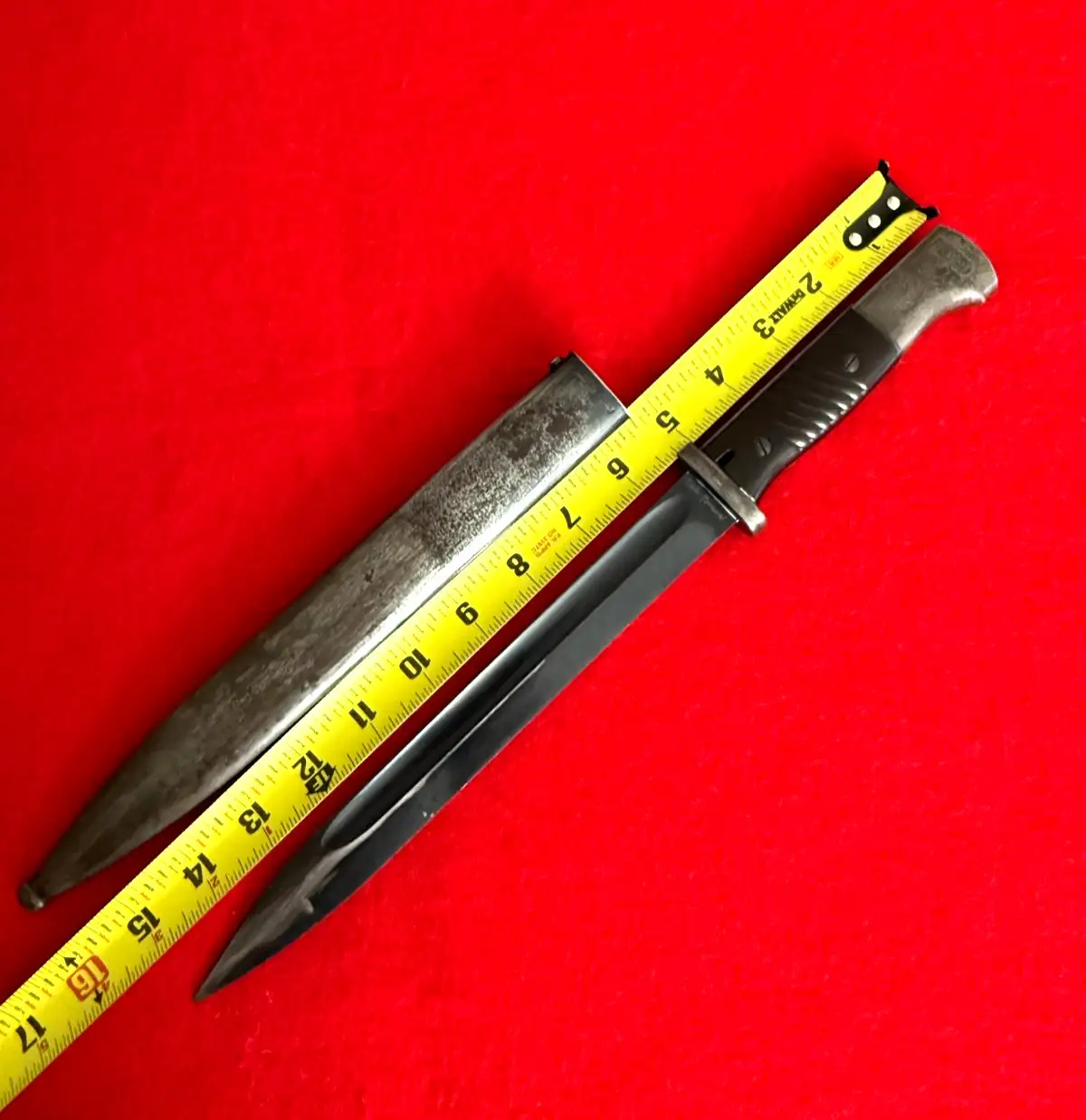
The Karabiner 98k was adopted on 21 June 1935. Its bayonet, the Seitengewehr 84/98 III, runs 385 mm overall with a 252 mm blade and has no muzzle ring. The Gewehr 98 of April 1898 had introduced a T-shaped bar under the barrel, so that the bayonet could be carried without a ring clamped round the muzzle — a ring altered the barrel's vibration under fire and cost accuracy — and the K98k kept the arrangement. That is why one blade pattern fits rifles built decades apart.
The makers were Solingen cutlery and sword houses, and the marking rules changed, which is the collector's clock. From 1934 the maker was carried by a code: S/ and three digits, with a K suffix for 1934 and a G for 1935. S/155 is E. u. F. Hörster, S/172 Carl Eickhorn, S/173 Alexander Coppel, S/174 Weyersberg, Kirschbaum — four Solingen firms. From 1937 the full company name and town went onto the ricasso in plain letters. From 1940 a three-letter code took over; cof is Eickhorn again, cvl Weyersberg, Kirschbaum. In 1940 itself all three systems appear, which is why that year confuses people.
Mauser's own receiver codes run S/42, then 42, then byf, then svw in 1945. Those belong on a rifle body. A byf on a receiver means Oberndorf; it does not appear on a K98k bayonet ricasso, because Oberndorf was not making them.
Mauser was written into the rearmament of the Wehrmacht from the 1930s and became one of the principal producers of the K98k. More than 5,000 forced labourers were put to work at the plant, and accounts of the wider Oberndorf district count roughly 7,000 people from nineteen nations in forced labour, housed in eight barrack camps and seven hostels.
What the occupation left
Oberndorf ended up in the French occupation zone. Production restarted under French administration and ran into 1946; rifles from that period carry the svw code. Then the military government ordered the plant taken apart, with the final dismantling decided in December 1946.
Workers and equipment began moving to the Mulhouse area in 1946, and the transfer was complete by March 1948. Factory buildings at Oberndorf were demolished. Most of the company records were destroyed on the local French commander's order, which is why so many questions about individual Mauser products have no paper answer and never will. When the dismantling ended, 160 jobs remained out of about 9,000.
Three engineers from the wreckage — Edmund Heckler, Theodor Koch and Alex Seidel — registered Heckler & Koch at Oberndorf on 28 December 1949. Mauser itself was reconstituted, became a Rheinmetall subsidiary in 1995 as Mauser-Werke Oberndorf Waffensysteme GmbH, and was merged into Rheinmetall Waffe Munition in 2004.
The name outlasted the state factory, the brothers, Berlin ownership, two wars and the dismantling. That is why it keeps turning up on objects ground in Solingen by people who never drew a Mauser wage.
What to look for
- Read the ricasso for the maker and the reverse edge of the blade for the year: German bayonets of the 1930s and 1940s carry the last two digits of the year on the spine, not on the ricasso face.
- An S/ prefix followed by three digits is a 1930s maker code — S/155 is E. u. F. Hörster, S/172 Carl Eickhorn, S/173 Alexander Coppel, S/174 Weyersberg, Kirschbaum, all of Solingen — and a K suffix marks 1934, a G suffix 1935.
- A company's full name and town spelled out on the ricasso points to 1937 or later; a three-letter code such as cof (Eickhorn) or cvl (Weyersberg, Kirschbaum) points to 1940 or later.
- WAFFENFABRIK MAUSER A.G. OBERNDORF a/N. on a ricasso belongs to S98/05 production dated 1915 to 1918; on a blade of any other period, treat it as a question.
- byf, svw, S/42 and 42 are Oberndorf rifle receiver codes, and their place is on a receiver — finding one on a K98k bayonet ricasso is a reason to look harder, not a confirmation.
- A Gewehr 98 or K98k bayonet has no muzzle ring, because the rifle carries a T-bar under the barrel instead; if a piece sold as one has a ring for the barrel, it belongs to a different rifle.